Home › Cat Care › Playing With Multiple Cats
Playing With Multiple Cats: How to Run Fair Play Sessions When One Cat Always Steals the Toy
Guest post: This article was contributed by Cidero & Co., a cat enrichment brand. Health and safety points were checked by our veterinary reviewer. It doesn’t replace advice from your own veterinarian.
If you live with multiple cats, you already know the scene: you pull out a feather wand, and the same bold cat charges in every time while the other cat watches from under the couch. Playing with multiple cats can feel like refereeing a lopsided game, and over time the shy cat just stops showing up.
This article walks you through step-by-step methods for running safe, fair play sessions in any multi cat household – whether you have two cats or five. The advice here is grounded in current feline behavior guidance, including the 2024 AAFP intercat tension guidelines and resources from the Cornell Feline Health Center, and it’s written in plain language for everyday cat owners.
You don’t need special equipment. A couple of simple toys, some observation, and patience will get you far. No punishment, no forcing animals to share, and no grabbing cats mid-scuffle.
What you will learn:
- How to read body language to tell relaxed play from tension or bullying
- How to use parallel play so each cat gets their own toy and attention
- How to run turn-based play when both cats love the same wand
- Clear signs that a session needs to pause, and how to stop safely
- When it’s time to seek veterinary or qualified feline behavior help
Is It Play or a Problem? Reading Multi-Cat Body Language
Cats are naturally solitary hunters, and they don’t “share” toys the way a pair of dogs might split a tennis ball. Rough play between cats can look alarming, so the first skill to develop is telling the difference between play that’s reciprocal and activity that’s one-sided.
Signs of relaxed, reciprocal play:
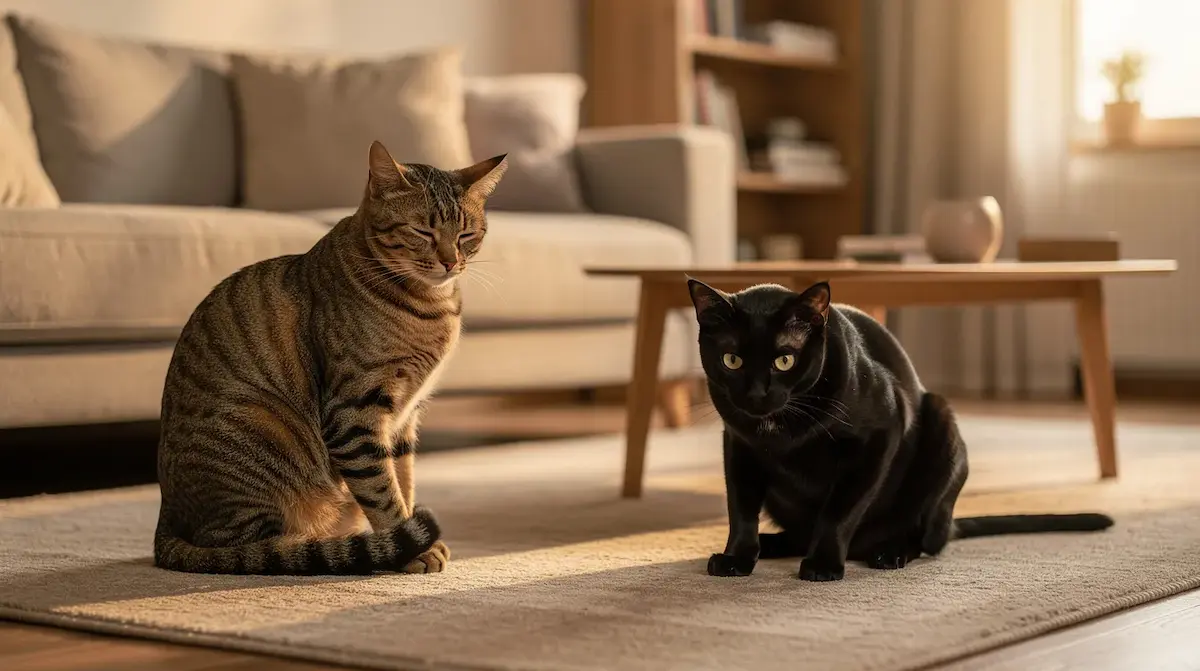
- Loose, wiggly bodies – not stiff or frozen
- Tails curved and fluid, not bristled
- Ears forward or neutral, whiskers relaxed
- Role reversals – one cat chases, then the other cat chases back
- Both cats return to the game voluntarily and may relax or groom nearby afterward
Signs of tension, bullying, or resource avoidance:
- Hard staring – direct eye contact held without blinking
- Blocking doorways, hallways, or access to litter boxes and food
- One-sided chasing where only one cat initiates and the other retreats every time
- Hiding under beds or furniture at the sight of the confident cat
- Hissing, growling, swatting with claws out, tail lashing, or piloerection (raised fur)
- Resource avoidance: one cat stops using a favorite litter box, won’t pass the other cat to reach water, detours around a room, or waits until the bold cat sleeps before eating
Monitor body language for signs of overstimulation during play – dilated pupils, flattened ears, and a lashing tail all mean excitement has crossed into stress. If play sessions regularly end with one cat retreating, hiding, or refusing to approach toys when the “bully” is present, that’s a red flag worth addressing because the pattern can increase the risk of ongoing stress.
Supervised interactions allow you to catch these patterns early, before they become habits. According to the 2024 AAFP intercat tension guidelines, surveys of multi-cat households find that 62% to 88% of caregivers observe signs of intercat tension – so this is not a rare problem.
Setting the Stage: Environment and Resources for Multiple Cats Before Play
Fair play starts long before you pick up a toy. The overall setting of your home determines whether cats feel safe enough to engage without competing. Providing multiple resources prevents competition and stress among cats, and a few adjustments can change the entire dynamic.
Litter boxes
- Follow the N+1 rule for litter boxes: provide one litter box per cat plus one extra. Two cats means three litter boxes, placed in different rooms.
- Keep multiple litter boxes accessible without passing close to the dominant cat’s favorite posts.
- Remove waste from litter boxes once or twice daily. Change litter completely every month for hygiene, and wash litter boxes with mild detergent monthly.
Food and water
Each cat needs separate food and water bowls in different areas of the home. Feeding stations placed out of each other’s sightlines prevent guarding. When feeding new cats in the same space, do so only when both animals are calm.
Vertical space and retreats
Maximizing vertical space – cat trees, shelves, the back of a sturdy sofa – can reduce tension among cats. Vertical spaces enhance exploration and comfort, giving every cat options for retreat.
Cats need individual spaces to reduce stress. Setting up hiding spots, boxes, or small closets with beds helps shy cats feel more secure. Separate areas help cats feel secure and relaxed, and providing hiding spots promotes privacy and reduces anxiety.
Create low-stimulus safe zones for overstimulated cats: a quiet room with a bed, water, and a litter box where they can reset emotionally after conflicts.
Play area layout
Pick a room with at least two exits. Cats should have escape routes to avoid feeling cornered during play. Avoid dead ends or narrow corridors where one cat can trap another.
For multi-cat homes in an apartment, even if adding a second perch and moving one litter box out of a tight hallway feels like a lot, small layout changes still make a difference. Use vertical levels and tunnels to enhance playtime in limited space.
A UK caregiver study found that cats given 25 or more minutes of play per day had fewer problem behaviors, while multi-cat homes with unmet resource and play needs showed significantly higher rates of issues like inappropriate elimination.
Parallel Play: How to Entertain Multiple Cats Without Competition
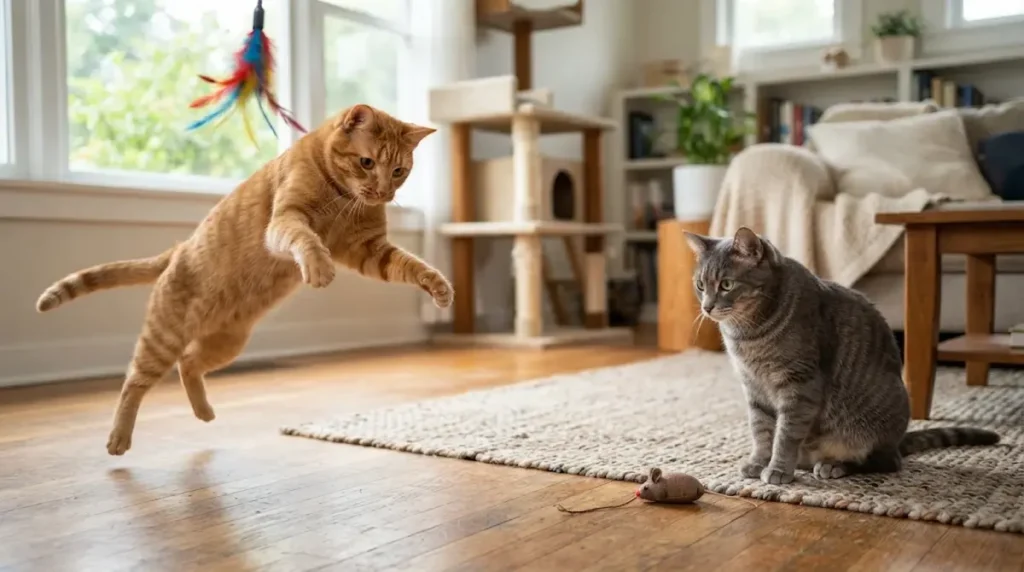
Parallel play means each cat plays near you in the same space, but focused on their own toy instead of a single shared item. It’s the simplest way to offer fair play when one cat always steals the toy.
When to use it: when new cats are still adjusting, when tension signs show up during shared games, or any time the confident cat monopolizes toys. Successful group play relies on preventing one cat from monopolizing toys, and parallel play handles this by design.
Step-by-step process:
- Start with both cats in the same room, spaced several feet apart.
- Give each cat their own toy – for instance, a feather wand for one and a ground “mouse” lure on a string for the other, or two separate kick toys tossed in opposite directions.
- Position yourself closer to the shyer cat at first so they get attention and encouragement before the bolder cat muscles in.
- Keep sessions to 5–10 minutes, once or twice a day. End on a calm note before anyone gets overstimulated.
Physical barriers can help manage dominant cats during play sessions – a baby gate or doorway works well early on, letting cats see each other without direct competition. Interactive toys provide vigorous activity even in limited spaces, so a small room is fine.
Cats benefit from opportunities to choose when to play together or alone. If one cat opts to sit out and watch, that’s acceptable. Don’t force participation.
Turn-Based Play: Giving Each Cat a Fair Chance With the Same Toy
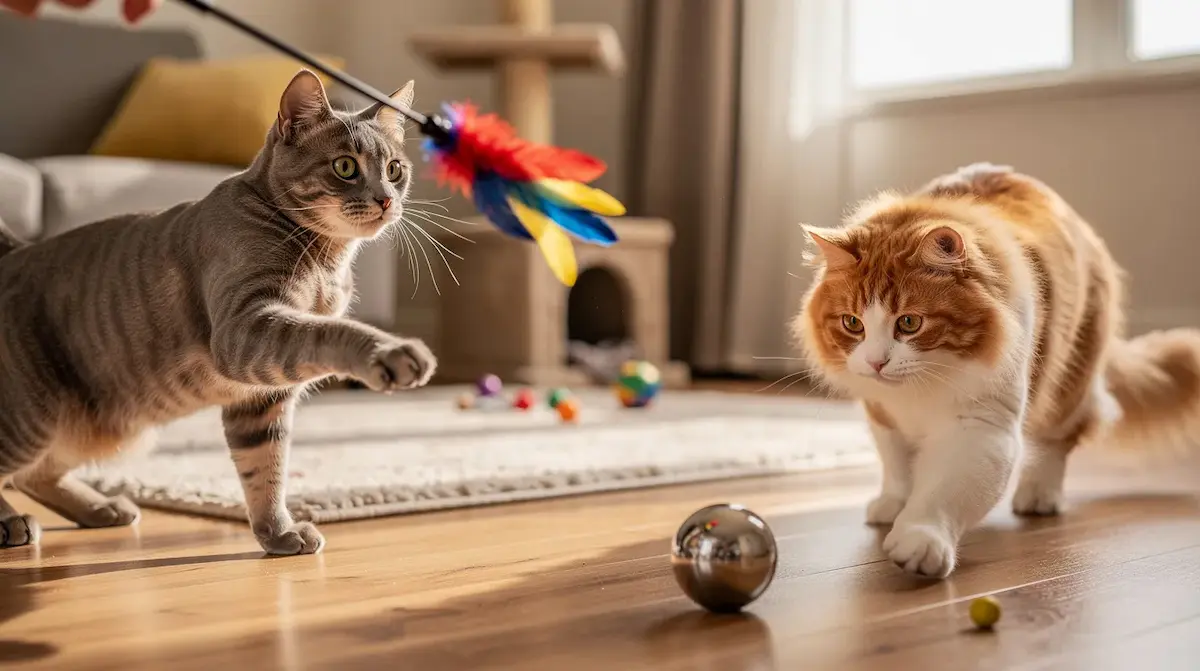
When both cats love the same wand toy, turn-based play lets each enjoy it without pressure to share simultaneously. Creating a predictable routine helps cats feel comfortable in shared spaces, and turn-taking builds that routine.
A concrete script to follow:
- Seat both cats in the same room with you.
- Work the wand for cat A for 30–60 seconds – a short, intense burst of activity.
- Visibly shift your body and the toy toward cat B. Use your leg or a cushion as a gentle barrier to cat A – never your hands.
- Play with cat B for 30–60 seconds.
- Alternate turns, keeping each round short before excitement builds too high.
- Use name cues to add predictability: “Milo’s turn… okay, Luna’s turn.”
For the toy-hogger: when it’s not their turn, redirect them with tossed treats or a stationary kicker toy so they have something acceptable to focus on. Rotate toys and scatter treat puzzles to prevent resource guarding during these sessions.
Never physically grab or hold a cat in place to enforce a turn. If redirection doesn’t work, run separate brief sessions instead. End play sessions calmly to reinforce positive behavior and trust – let the toy slow down gradually rather than yanking it away.
Establishing playtime routines like this fosters positive interactions among cats. As they learn the rhythm over a number of days, sessions can stretch a bit longer – but always stop before frustration appears.
When One Cat Always Steals the Toy: Practical Adjustments
Many homes with multiple cats have one “sports star” and one “benchwarmer.” That’s normal. Here’s how to level the field without punishing the bold cat.
Position yourself as a barrier. Sit or kneel between the cats so the shy cat is physically closer to you and the toy. Your body blocks the toy-stealer without any confrontation.
Start with the less confident cat. Play with that cat first for a couple of minutes before inviting the bold one to join. This gives the timid pet a head start.
Double-distraction tactics: Use a long wand toy so you can swing one end near cat A while flicking a second toy or treat for cat B in the opposite direction. Throwing small treats quickly draws the bold cat away, giving the timid cat a few extra seconds.
Rotate pairs. If you have more than two cats, play A+B, then B+C, so quieter cats get at least one session without the dominant player present.
Safe toy choices: opt for long fishing-rod wands (to keep your hands distant from the action), soft balls that can be rolled in two directions, and sturdy kickers one cat can enjoy alone.
Regularly rotating toys keeps the play environment fresh and engaging. Cats get bored with the same list of items quickly, so swapping in new textures or shapes every few days keeps everyone interested.
Knowing When to Pause: Safe Interruptions and Cool-Downs
Short, positive play beats long, chaotic play every time. Pausing early prevents fights and protects the trust you’re developing between cats and between each cat and you.
Signs it’s time to stop:
- Fixed staring between cats
- Tail lashing, ears flattening, low growls or hissing
- One cat repeatedly pinning or overwhelming the other cat
- One cat hiding under furniture mid-session or refusing to engage further
Safe ways to interrupt:
- Let the toy “die” – stop all movement and gently drop it
- Toss a handful of dry food or treats away from both cats to redirect without touching
- Clap softly or say names in a calm, neutral voice, then guide cats toward different areas of the room
What to avoid: never put bare hands between fighting cats, yell, or squirt water. These increase fear, raise stress levels, and damage the bond between you and your pets.
After stopping, allow a 10–20 minute cool-down. Dim lights a bit, offer access to high perches or hiding spots, and let cats find their own space to relax. Remember that cats need personal retreats to reset emotionally after conflicts.
If pauses are needed in every session despite careful management, that may point to deeper intercat tension requiring professional help.
Supporting Shy or Bullied Cats: Confidence Without Conflict
In many homes with multiple cats, one cat is simply more timid. The process of building that cat’s confidence takes time – and it never involves punishing the bolder cat.
Daily one-on-one sessions. Invite the shy cat into a quiet room with the door closed. Use toys they can “win” easily – something that moves slowly and is catchable. This builds affection for play and trust in you.
Reward presence. Use treats and praise when the shy cat stays in the same room during parallel or turn-based play, even if they only watch at first. Encourage shared exploration to build positive associations between cats over time.
Safe retreats. Cat trees, shelves, boxes – anything that offers a view of the room from a secure height. Cats enjoy climbing and exploring vertical spaces for engagement, and elevated spots double as emotional safe zones.
Duplicate resources. If the shy cat avoids certain litter boxes, sleeping areas, or routes because of the confident cat, add alternatives in quieter territory. Individual spaces reduce stress for each cat.
Don’t forget the bold cat. The confident cat also needs individual play and attention so they don’t feel they must compete constantly for your love and interaction.
When bringing new cats into the home, begin introductions gradually to prevent territorial behavior. Scent swapping helps cats acclimate to each other, and gradual introductions reduce anxiety and potential conflicts. Even video call interactions – such as letting cats hear each other through a screen before meeting – can be a safe early step. Separate spaces help cats feel secure during introductions.
Adopting two cats provides lifelong companionship, and multiple cats reduce boredom and destructive behavior for each other. Multiple cats can even help each other with grooming issues. But making those lives work smoothly together requires the kind of thoughtful setup described here.
When to Call in Help: Veterinary, Litter Boxes, and Behavior Support
Needing help doesn’t mean you’ve failed. Some combinations of animals simply require professional support, and the sooner you get it, the better the outcome for every cat in your home.
See a veterinarian first if you notice:
- Sudden change in how one cat plays or interacts – withdrawal, irritability, or new aggression
- Urine or stool outside the litter box, especially near doors or toys
- Injuries, overgrooming, weight loss, or reluctance to jump
- Pain from issues like arthritis, dental disease, or urinary problems can turn normal play into aggression, and medical causes must be ruled out
Consult a qualified feline behavior professional if:
- Staring, blocking, or bullying happens daily despite environmental changes
- One cat rarely leaves one room or hides whenever you bring out toys
- Fights break out during or after play despite careful management
The 2024 AAFP intercat tension guidelines note that 25–31% of feline behavior cases presented to specialists involve intercat tension. The Cornell Feline Health Center is a reliable place for cat owners to find more on multi-cat behavior and aggression.
Behavior work typically involves changing the environment, increasing resources like litter boxes and resting spots, and adjusting play – not punishing cats. Each cat requires its own food and water bowls to prevent conflict, and adopting multiple cats increases overall care costs significantly, but the investment in proper setup and professional guidance pays off in calmer, healthier lives for everyone.
On average, 3 to 4 million cats are euthanized yearly in shelters. Keeping multi-cat homes stable and happy matters – not just for the cats already in your home, but for the broader goal of making adoption sustainable.
Conclusion
In homes with multiple cats, fair play comes from reading body language, offering enough resources, and using parallel and turn-based play instead of forcing cats to share a single toy at once. None of this requires expensive gear or expert-level skills – just consistent effort and a willingness to watch, adjust, and stay patient.
Keep an eye on tension signs – staring, blocking, one-sided chasing, hiding, hissing, growling, and litter box avoidance – and pause sessions early when you spot them. Adjust your routine over time as each cat’s comfort and confidence change. And if play regularly turns into conflict, reach out to your vet or a qualified feline behaviorist before things escalate.
Key takeaways:
- Read body language before, during, and after every play session
- Set up the home with enough litter boxes, feeding stations, vertical space, and hiding spots to reduce competition
- Use parallel play (separate toys) and turn-based play (alternating turns) to ensure every cat gets a fair chance
- Pause early and calmly – never punish or force cats together
- Seek veterinary or behavior help when tension persists despite your best efforts
Share your thoughts or questions about playing with multiple cats in the comments.
This article was drafted with AI assistance and then fact-checked and edited for accuracy and welfare-focused content. It is not based on personal clinical experience. Sources include the 2024 AAFP intercat tension guidelines and the Cornell Feline Health Center.
Candice Chan is the founder of Cidero & Co., a cat enrichment brand focused on making indoor life more engaging for cats. With a particular interest in feline play, interactive toys, and everyday enrichment, Candice enjoys exploring practical ways to help cat parents create more stimulating and comfortable home environments for their feline companions. Learn more at Cidero & Co.
Join the Happy Cat Club: one short, vet-reviewed email a week with behavior, enrichment and care tips for indoor cats. No spam, unsubscribe anytime.