Home › Cat Feeding › How to Help Your Cat Lose Weight
Disclosure: Happy Cat At Home is reader-supported. Links to PETLIBRO are affiliate links, so we may earn a commission at no extra cost to you. How we make money.
How to Help Your Cat Lose Weight Safely: A Vet’s Plan, Calorie Calculator and Tips

Last updated: · Based on veterinary weight-management guidance
How do I help my cat lose weight safely?
To help a cat lose weight safely, feed a measured daily calorie target of about 80% of the resting energy requirement at its ideal weight, aim for a loss of 1 to 2% of body weight per week, and add daily play. Swap free-feeding for scheduled meals, choose a high-protein or high-fiber diet your vet approves, keep treats under 10% of calories, and weigh your cat every week. Never put a cat on a crash diet, because rapid weight loss can cause fatty liver disease.
- ⚖️ Check first: is my cat overweight?
- 🧮 Get your number: cat weight loss calculator
- 🐢 Go slow: how fast a cat should lose weight
- 🏃 Move more: exercise ideas for indoor cats
How can I tell if my cat is overweight?
A cat is overweight when you cannot easily feel its ribs, it has no visible waist from above, and its sides bulge, which equals a body condition score (BCS) of 6 or more on the 9-point scale. On the World Small Animal Veterinary Association (WSAVA) scale, 5 is ideal, 6 to 7 is overweight and 8 to 9 is obese. In a 2022 survey by the Association for Pet Obesity Prevention (APOP), 61% of US cats were classified as overweight or obese, so an overweight cat is the norm rather than the exception.
Body condition matters more than the number on the scale. Each BCS point above 5 is commonly estimated at about 10% extra body weight, so a cat with a BCS of 7 is roughly 20% heavier than its ideal. Long hair and the loose “primordial pouch” on the belly can hide a cat’s shape, so run your hands along the ribs and spine rather than judging by looks alone.
Ribs easy to feel under a thin fat layer, a visible waist behind the ribs, and only a small belly pouch.
Ribs hard to feel, no waist, a rounded belly, and fat over the spine and base of the tail.
Excess weight shortens and limits a cat’s life. Obesity raises the risk of diabetes, arthritis, urinary tract disease, skin problems and liver disease, and it makes anesthesia riskier. Overweight cats also tire easily and often stop grooming their lower back, which leads to matted, greasy fur.
How many calories should my cat eat to lose weight? Use the calculator
The cat weight loss calculator sets a daily calorie target of 80% of your cat’s resting energy requirement at its ideal weight, then turns it into cups and cans. Resting energy requirement (RER) is 70 × (ideal weight in kg)0.75, and feeding 80% of it usually produces the safe loss rate of about 1 to 2% per week. Ask your vet to confirm your cat’s ideal weight before you start.
Food amounts already leave 5% of calories for treats. Weigh your cat weekly: if loss is over 2% a week, add about 10% more food; if it is under 1%, reduce by 5 to 10%. Confirm the plan with your veterinarian, especially for cats with diabetes, kidney disease or a BCS of 8 to 9.
How much should an overweight cat eat a day?
An overweight cat usually needs about 130 to 225 kcal a day during weight loss, depending on its ideal weight, which is often less than half to two-thirds of a cup of dry weight-control food. The table below uses 80% of RER at the ideal weight, a dry weight-control food at 350 kcal per cup and a wet food at 80 kcal per 3-oz can. Base the calories on the ideal weight, never on the current weight, or your cat will not lose.
| Ideal weight | Weight-loss calories (kcal/day) | Dry food at 350 kcal/cup | Wet food at 80 kcal per 3-oz can |
|---|---|---|---|
| 7 lb (3.2 kg) | 133 | 0.38 cup | 1.7 cans |
| 8 lb (3.6 kg) | 147 | 0.42 cup | 1.8 cans |
| 9 lb (4.1 kg) | 161 | 0.46 cup | 2 cans |
| 10 lb (4.5 kg) | 174 | 0.5 cup | 2.2 cans |
| 11 lb (5.0 kg) | 187 | 0.53 cup | 2.3 cans |
| 12 lb (5.4 kg) | 200 | 0.57 cup | 2.5 cans |
| 13 lb (5.9 kg) | 212 | 0.61 cup | 2.65 cans |
| 14 lb (6.4 kg) | 224 | 0.64 cup | 2.8 cans |
Pet food bag guidelines are written to maintain weight, not lose it, which is why cats rarely slim down when owners follow the label. If you want to see your cat’s maintenance needs for comparison, use our how much to feed a cat calculator.
How fast should a cat lose weight?
A cat should lose no more than 1 to 2% of its body weight per week, which is only about 0.16 to 0.32 lb a week for a 16-lb cat. At that pace, a cat going from 16 lb to 12 lb needs roughly 14 to 29 weeks, so a realistic plan takes 4 to 7 months. Slow loss protects the liver and is far more likely to last.
Weekly weigh-ins tell you whether to adjust the plan. Weigh your cat at the same time each week, on the same scale. If your cat loses more than 2% in a week, increase food by about 10%; if it loses less than 1%, reduce food by 5 to 10%. Small, steady corrections work better than big cuts.
What is the best diet for an overweight cat?
The best diet for an overweight cat is a complete, balanced weight-control food that is high in protein and either high in fiber or low in fat and carbohydrates, fed in measured amounts. High-protein, low-carbohydrate diets slow stomach emptying and help preserve muscle during weight loss. High-fiber, low-fat diets add bulk so the cat feels full on fewer calories.
Wet food is one of the simplest tools for weight loss. Because it is about 75 to 80% water, a cat can eat a larger, more satisfying portion for the same calories as a small pile of kibble. For cats with a lot to lose (BCS 8 to 9), diabetes or other conditions, veterinarians often prescribe a therapeutic weight-loss diet, which is designed to keep nutrients complete even at low calorie intake.
Change foods gradually to avoid stomach upset and refusal. Mix about a quarter of the new food with the old food for a few days, then half and half, then three quarters new, over about 1 to 3 weeks. Picky cats may need longer; never let a cat go without eating while it “gets used to” a new diet. Avoid feeding only a reduced amount of a regular adult food for long periods, because cutting portions too far can also cut essential nutrients.
How should I feed my cat to help it lose weight?
Measured, scheduled meals are the most effective feeding change for weight loss, because free-feeding makes it almost impossible to control calories. Weigh the whole day’s food on a kitchen scale each morning, then split it into 3 to 4 small meals. Small, frequent meals help control hunger and reduce begging.
- Stop free-feeding: remove the always-full bowl and switch to measured meals.
- Weigh, don’t scoop: measure kibble in grams; a level “cup” varies a lot.
- Slow the eating: use puzzle feeders or treat balls so meals take longer and keep your cat busy.
- Cap the treats: keep treats under 10% of daily calories, ideally about 5%, and count them in the daily total.
- Replace food with attention: answer begging with play or brushing instead of a snack.
Let a feeder hold the line on portions
- PETLIBRO Granary WiFi feeder: serves exact portions in several small meals a day, so there is no “extra scoop” and no 5 a.m. begging at your bed.
- Precise control: set the daily total from the calculator once and adjust it by 5 to 10% after each weekly weigh-in.
Affiliate link · Compare models in our best automatic cat feeder guide
How do I help a cat lose weight in a multi-cat home?
In a multi-cat home, the overweight cat must eat separately, either in a closed room at mealtimes or from a microchip feeder that opens only for its own chip. Shared bowls let the heaviest eater take everyone’s food, and the leanest cat often loses out. Feeding each cat its own measured portion is the only way to know who eats what.
Simple layouts also help. Feed a lean, agile cat on a high shelf the overweight cat cannot reach easily, and pick up all bowls after 20 to 30 minutes. A microchip feeder is the most reliable option when one cat needs a prescription weight-loss diet and the others do not.
PETLIBRO One RFID Pet Feeder
Opens only for the microchipped or tagged cat it is set for, so the dieting cat cannot raid the others’ bowls, and the others cannot finish its diet food.
Affiliate link
How can I get my indoor cat to exercise more?
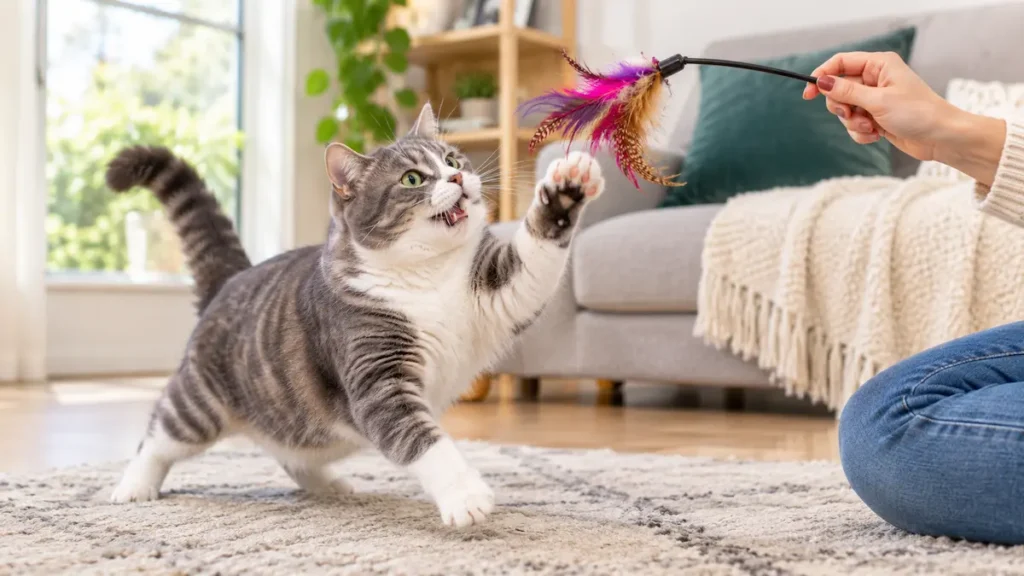
Indoor cats exercise most when play copies hunting: short, intense bursts with a wand toy or moving target, a few times a day, ending with a “catch.” Exercise supports weight loss and protects muscle, but it does not replace calorie control. A cat cannot run off an extra scoop of kibble.
- Wand and feather toys: two or three short sessions a day, letting your cat stalk, chase and pounce.
- Vertical space: cat trees and wall shelves encourage climbing and jumping. See our cat trees for large cats.
- Food hunting: hide part of the daily kibble in puzzle toys or around the house so your cat works for meals.
- Safe outdoors: harness walks or a catio add new sights and movement.
Start gently with very heavy or older cats, who may have joint pain. More ideas are in our guides to exercising your cat at home and indoor cat enrichment.
What if my cat is not losing weight?
A cat that is not losing weight is usually still eating more calories than planned, most often from treats, other pets’ food, extra scoops or a family member feeding “just a little.” Re-weigh the daily portion, count every treat, and make sure only one person feeds the cat. Then reduce the daily calories by 5 to 10% and re-check in 2 weeks.
If weight still does not move after careful changes, see your vet. Conditions such as hypothyroidism are rare in cats, but medications, arthritis that limits movement, or a diet that is too calorie-dense can all stall progress. Once your cat reaches its goal, increase food by about 10% and keep weighing monthly, because many cats regain weight when owners go back to old habits.
Frequently asked questions
How long does it take for a cat to lose weight?
Most overweight cats need about 4 to 7 months to reach their ideal weight, and very obese cats may need a year. A safe rate of 1 to 2% of body weight per week means a cat losing 4 lb takes roughly 14 to 29 weeks. Faster loss is risky.
How can I help my cat lose weight naturally?
The natural way to help a cat lose weight is fewer, measured calories plus more daily activity, without crash dieting or supplements. Switch to scheduled meals, add more wet food, use puzzle feeders and play with your cat two or three times a day. Weigh weekly and adjust slowly.
Is wet food better for weight loss in cats?
Wet food often helps cats lose weight because its high water content makes portions larger and more filling for the same calories. Wet food is also usually higher in protein and lower in carbohydrates than dry food. Calorie control still matters more than food type.
How do I help one cat lose weight when I have multiple cats?
Feed the overweight cat separately, in its own room or with a microchip feeder, and remove all bowls after meals. Free-feeding a shared bowl makes weight loss almost impossible. Each cat should get its own measured portion.
How much weight loss is too fast for a cat?
Losing more than 2% of body weight per week is too fast for a cat. For a 15-lb cat, that is more than about 0.3 lb a week. Rapid loss raises the risk of fatty liver disease, so increase food by about 10% and call your vet.
Can my cat still have treats on a diet?
Yes, a cat on a diet can have treats, as long as they make up no more than 10% of daily calories and ideally about 5%. Use low-calorie treats or set aside a few pieces of the daily kibble as rewards. Count every treat toward the daily total.
- Association for Pet Obesity Prevention, 2022 Survey Reveals Alarming Rates of Pet Obesity in the US
- petMD, Cat Dieting: How to Help Your Cat Lose Weight
- Catster, Cat Diets: How and Why to Put Your Cat on a Diet Safely
- World Small Animal Veterinary Association, Global Nutrition Guidelines and Body Condition Score tools
- Hand MS et al., Small Animal Clinical Nutrition, 5th ed., 2010 (energy requirement formula)
Vet note: this guide and calculator are for healthy adult cats. Cats with diabetes, kidney disease, heart disease or a body condition score of 8 to 9 need a weight-loss plan set and monitored by their own veterinarian.