Home › Cat Breeds › Maine Coon Cat
Maine Coon Cat: Size, Personality, Lifespan, Price and Breed Facts (Vet-Reviewed)
 Written & medically reviewed by Dr. Muhammad Usama, DVM, RVMP· PVMC license no. 9472
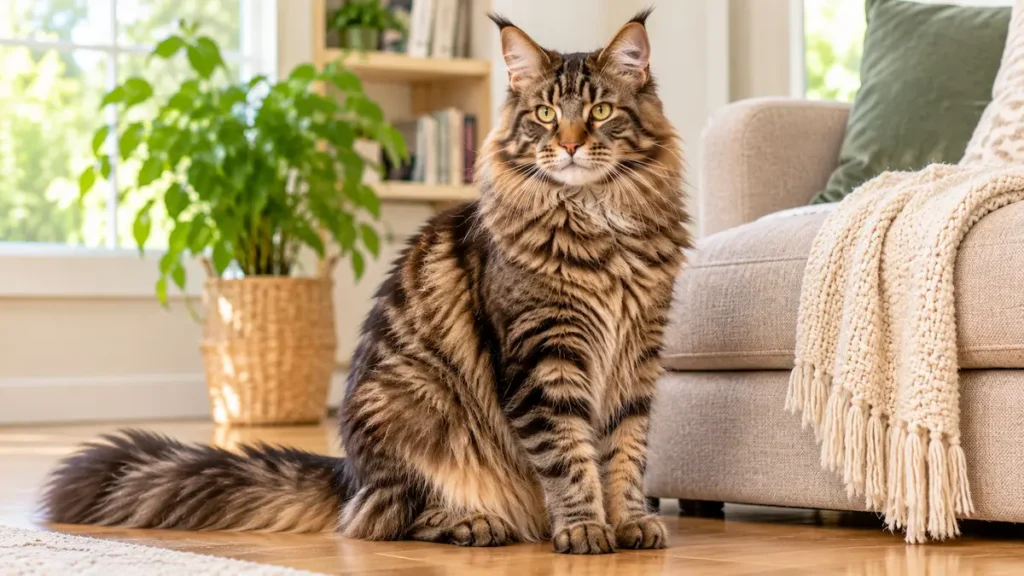
OriginUnited States (Maine)
Height10–16 inches
Adult weight9–18 lb (some males 20–25)
Life span12–15 years
Is a Maine Coon cat right for you?
The Maine Coon is a large, friendly, slow-maturing longhaired cat from the United States: males usually weigh 13 to 18 pounds, females 9 to 13 pounds, and most live about 12 to 15 years. It suits families, first-time owners and multi-pet homes that want a social “gentle giant” and can handle weekly brushing, bigger supplies and heart screening. It is a poor fit if you need a hypoallergenic cat, a small apartment cat with a tiny budget, or a cat that ignores you all day.
- 📏 Size: one of the largest domestic breeds; full size at 3 to 5 years
- ❤️ Personality: affectionate, playful, chatty with chirps and trills, rarely clingy
- 🩺 Health watch: hypertrophic cardiomyopathy (HCM), spinal muscular atrophy (SMA), hip dysplasia
- 💰 Price: about $400 to $4,500 for a pet-quality kitten depending on source; rescue fees are far lower
Maine Coon quick facts
The Maine Coon is America’s native longhaired breed, known for its large size, tufted ears, bushy tail and dog-like friendliness. Here is the breed at a glance, with each figure taken from a registry, vet or breed source listed at the end of this guide.
- Origin
- United States (state of Maine)
- Breed group
- Large, semi-longhair
- Height
- About 10 to 16 inches at the shoulder
- Adult weight
- Males 13 to 18 lb · females 9 to 13 lb (some males reach 20 to 25 lb)
- Full grown
- 3 to 5 years
- Lifespan
- About 12 to 15 years (sources range from 9 to 15+)
- Coat
- Shaggy, water-resistant semi-longhair; heavier ruff and britches
- Grooming
- Brush 2 to 3 times a week; nails every 2 to 3 weeks
- Shedding
- Moderate to heavy, with a big spring shed
- Temperament
- Gentle, social, playful, intelligent, chirps and trills
- Good with kids and dogs
- Usually yes, with normal introductions
- Hypoallergenic
- No
- Popularity
- Ranked #1 by the Cat Fanciers’ Association (CFA) in 2026
- Other names
- Maine Cat, Coon Cat, Maine Shag, American Forest Cat, “Gentle Giant”
Maine Coon breed scorecard
On our 1 to 5 scale, the Maine Coon scores highest for affection, kid-friendliness and pet-friendliness, and lowest for low-maintenance grooming and low shedding. These are editorial ratings by Dr. Usama based on the breed sources below, not a lab test; individual cats vary.
- AffectionBonds closely with the whole family and follows people from room to room. 5/5
- PlayfulnessStays kitten-like for years; loves wand toys and fetch-style games. 4/5
- Activity levelModerate: bursts of play, then long naps. Not as restless as a Bengal. 3/5
- Grooming needLong belly and britches fur mat without brushing 2 to 3 times a week. 4/5
- SheddingHeavy seasonal shed, mostly in spring. 4/5
- VocalTalks often, but with soft chirps and trills rather than loud yowls. 3/5
- Kid-friendlyPatient and sturdy; still supervise small children. 5/5
- Pet-friendlyUsually gets along with cats and cat-friendly dogs. 5/5
- Inherited health riskKnown gene risks (HCM, SMA) and hip dysplasia; screening lowers the risk. 3/5
- First-time owner fitEasygoing nature; the main extra work is brushing and bigger supplies. 4/5
Is a Maine Coon right for you? Good fit vs not a good fit
A Maine Coon is right for you if you want an interactive, sociable cat and have the space and budget for a big one. Use this checklist before you contact a breeder or rescue.
- Want a cat that greets you and joins in family life
- Have kids, a cat-friendly dog or another cat
- Can brush 2 to 3 times a week
- Have room for a large litter box and a sturdy cat tree
- Will pay for heart screening and a good vet
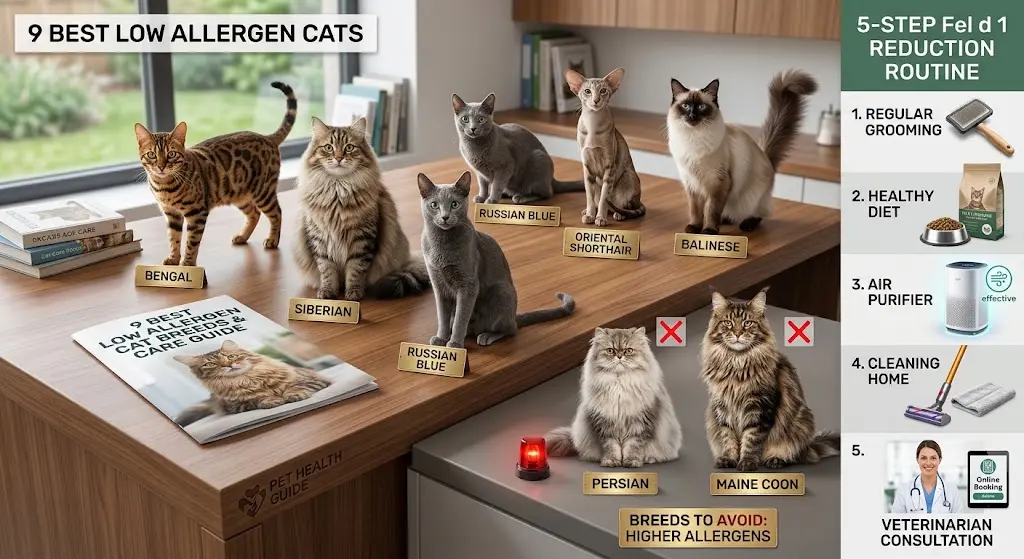
- Need a hypoallergenic cat (see cat breeds for people with allergies)
- Are away for very long days and want a fully independent cat
- Hate cat hair on clothes and furniture
- Can only fit standard-size litter boxes and small cat trees
- Have a tight budget for food and vet care
Maine Coon personality and temperament
Maine Coons are famous for a gentle, friendly temperament: they are affectionate without being needy, playful well into adulthood and usually calm with children and other pets. That mix is why owners and breeders call them “gentle giants.”
Most Maine Coons like to be near their people rather than on them. Expect a cat that follows you to the kitchen, sits beside you on the couch and supervises chores, but may not want to be held for long. They are smart and food-motivated, so many learn to play fetch, come when called or walk in a harness.
The breed’s voice is part of its charm. Instead of loud meowing, Maine Coons often “talk” with chirps and trills, especially when they want attention or spot birds through a window. If your cat is suddenly crying or yowling far more than usual, that is a different signal; see why your cat is crying.
Are Maine Coons good with kids and dogs?
Yes, Maine Coons are usually good with respectful children and cat-friendly dogs because of their size, patience and social nature. Introduce new pets slowly, give the cat high escape routes, and teach children to let the cat walk away. Our guide to introducing a cat to a dog walks through the steps.
Can a Maine Coon be left alone?
A healthy adult Maine Coon can handle a normal workday alone, but this social breed gets bored and lonely with long, daily absences. Puzzle feeders, window perches and a second cat help. Read how long you can leave a cat alone before planning trips.
Maine Coon size: how big do Maine Coons get?
Adult male Maine Coons usually weigh 13 to 18 pounds and females 9 to 13 pounds, and they stand roughly 10 to 16 inches tall at the shoulder. Exceptional males can reach 20 to 25 pounds, but a cat far above that is more often overweight than “extra large.” Length is where they stand out: from nose to tail tip, many adults measure about a yard or more.
When is a Maine Coon fully grown?
A Maine Coon is usually fully grown between 3 and 5 years old, much later than the typical house cat, which reaches adult size at about 1 year. They gain height and length first, then fill out with muscle and coat over the next few years. That slow maturity matters for food choice: feed a growth formula for the first year, then adjust portions to body condition rather than to a number on the scale.
| Age | Maine Coon growth stage | What to do |
|---|---|---|
| 0 to 4 months | Fastest growth; SMA signs, if present, usually show at 3 to 4 months | Kitten food, vaccines, ask the breeder for SMA and HCM gene results |
| 4 to 12 months | Rapid height and length gain; big appetite | Measured meals; see our kitten feeding chart |
| 1 to 3 years | Frame keeps lengthening; ruff and tail fill in | Switch to adult food; first heart scan is often advised from age 2 to 3 |
| 3 to 5 years | Reaches full adult size and coat | Keep a lean body condition; yearly vet checks |
Want to know your cat’s age in people years? Try the cat age calculator.
Maine Coon vs a regular cat: size difference
A typical adult Maine Coon is noticeably longer, taller and heavier-boned than a regular domestic shorthair, with a broader chest, larger paws and a much longer tail. The difference is biggest in males. If you are unsure whether your large cat is part Maine Coon, appearance alone cannot tell you; a Maine Coon mix DNA test can.
How big is the biggest Maine Coon?
The longest domestic cat verified by Guinness World Records is Barivel, a Maine Coon from Italy, measured at 120 cm (3 ft 11.2 in) in May 2018. Guinness does not run a “heaviest cat” record, so be wary of online claims about 30-pound-plus Maine Coons; extra weight shortens a cat’s life.
Maine Coon appearance, coat and colors
Maine Coons have a rectangular, muscular body, large tufted ears, a square muzzle, big “snowshoe” paws and a long, bushy tail, all covered in a shaggy, water-resistant coat. The coat is shorter on the shoulders and longer on the belly, legs (“britches”) and chest ruff, a design suited to harsh New England winters.
What colors do Maine Coons come in?
Maine Coons come in most colors and patterns, except chocolate, lilac and pointed (Siamese-style) coats, which are not accepted for the breed. Brown tabby is the classic look, but solids, silvers, smokes, torties and bicolors are common too. Eyes may be green, gold or copper; white cats may also have blue or odd eyes.
- Brown tabby
- Silver tabby
- Black
- White
- Red
- Blue
- Cream
- Tortoiseshell
- Bicolor
- Smoke
Swatches are simple color guides, not photos. Accepted colors vary slightly between registries (CFA, TICA, GCCF).
Maine Coon care: food, grooming, exercise and litter box
Maine Coon care is mostly normal cat care scaled up: more food, more brushing, bigger litter boxes and sturdier furniture. For a full week-by-week routine, read our Maine Coon care guide for beginners. Here is the short version.
Nutrition
Feed a Maine Coon a complete, high-protein cat food in measured portions, because their slow growth and big appetite make both underfeeding kittens and overfeeding adults easy. Large adults need more calories than a small cat, but extra weight strains hips and the heart. See Maine Coon food: how much, what type and our picks, or use the cat feeding calculator.
Grooming
Brush a Maine Coon 2 to 3 times a week, and daily during the spring shed, to prevent mats on the belly, armpits and britches. A wide-tooth comb plus a slicker or undercoat tool works best; see our best brushes for long-haired cats. Trim nails every 2 to 3 weeks and check ears and teeth weekly.
Exercise and enrichment
Maine Coons need two or three daily play sessions and tall, stable climbing spots to stay fit and content. Many standard cat trees wobble or are too small for a 15-pound cat, so choose a heavy base and wide perches; see the best cat trees for large cats and our indoor cat enrichment ideas.
Litter box and water
A Maine Coon needs a litter box about 1.5 times its body length, which rules out most standard boxes. Our sizing advice is in the best litter box for Maine Coons and what size litter box your cat needs. A wide, easy-to-clean cat water fountain can help a big cat drink more.
Maine Coon health problems and screening tests
The main inherited health problems in Maine Coons are hypertrophic cardiomyopathy (HCM), spinal muscular atrophy (SMA) and hip dysplasia, with polycystic kidney disease (PKD) reported less often. Good breeders screen for all of them, and you can ask your vet about follow-up tests.
Hypertrophic cardiomyopathy (HCM)
HCM is a thickening of the heart muscle and is the most important heart disease in Maine Coons; one gene variant, MYBPC3-A31P, raises the risk. In a study of 2,744 European Maine Coons, 41.5% carried this variant (Mary et al., 2010). Risk depends on how many copies a cat has: a 2011 study of 332 Maine Coons found that cats with two copies had much higher odds of HCM, while one copy did not significantly raise risk in young cats. Cats without the variant can still develop HCM, which is why vets pair a DNA test with a heart ultrasound (echocardiogram), often starting from age 2 to 3.
Spinal muscular atrophy (SMA)
SMA is an inherited nerve disease that weakens the back-leg muscles, with signs starting at about 3 to 4 months of age. It is not painful, and affected cats can live comfortably indoors, but they cannot jump well. It is recessive, so a kitten must inherit the gene from both parents; a DNA test reports N/N (clear), N/S (carrier) or S/S (affected).
Hip dysplasia
Hip dysplasia is an abnormally formed hip joint that can cause stiffness and arthritis, and it is more common in large breeds like the Maine Coon. Keeping your cat lean is the best home protection. Breeders can screen parents with hip X-rays.
Polycystic kidney disease (PKD)
PKD causes fluid-filled cysts in the kidneys and is listed as a breed risk by some insurers, though it is far more common in Persians. Ask whether the parents were scanned, and keep up with yearly bloodwork as your cat ages.
Which DNA tests should a Maine Coon have?
A Maine Coon kitten’s parents should have DNA results for HCM (MYBPC3-A31P) and SMA, plus heart ultrasound and hip X-ray reports. If you already own a Maine Coon or a Maine Coon mix, a consumer DNA kit can flag some of these markers; compare options in our best cat DNA test guide. Always confirm a positive result with your vet.
How long do Maine Coons live? Most live about 12 to 15 years. Lean weight, regular dental care (see signs of dental disease) and early heart screening give your cat the best chance at the upper end of that range.
How much is a Maine Coon cat?
A pet-quality Maine Coon kitten from a US breeder typically costs about $400 to $2,000 according to Cats.com, while Maine Coon Central reports $2,000 to $4,500 in 2026, and show or breeding cats can top $5,000. The wide gap reflects the breeder’s health testing, pedigree, region and color demand. Adoption through a rescue costs much less.
| Source | Typical cost | What’s usually included |
|---|---|---|
| Registered breeder, pet quality | $400–$2,000 (Cats.com); $2,000–$4,500 (Maine Coon Central, July 2026) | Spay/neuter contract, first vaccines, parents’ health tests |
| Show or breeding quality | $5,000–$6,500+ (Maine Coon Central) | Breeding rights, pedigree, show potential |
| Maine Coon rescue | About $250–$450 (example fees reported by Maine Coon Central) | Vet check, vaccines, usually spay/neuter |
Ongoing costs are higher than for an average cat. Plan for more food and litter, a large litter box and cat tree, grooming tools and possible heart scans. Because of the breed’s inherited risks, many owners also price pet insurance before bringing a kitten home.
Maine Coon vs Norwegian Forest Cat vs regular cat
The easiest way to tell a Maine Coon from a Norwegian Forest Cat is the head: the Maine Coon has a square muzzle and a gently curved profile, while the Norwegian Forest Cat has a triangular head and a straight nose. Both are big, fluffy, slow-maturing breeds, so this table covers the other differences.
| Trait | Maine Coon | Norwegian Forest Cat | Regular domestic cat |
|---|---|---|---|
| Origin | United States | Norway | Mixed |
| Adult weight | Males 13–18 lb, females 9–13 lb | About 12–16 lb | Smaller on average |
| Head shape | Square muzzle, high cheekbones | Equilateral triangle, straight nose | Varies |
| Coat | Shaggy, uneven length | Dense double coat, woolly undercoat | Mostly short |
| Full grown | 3–5 years | Up to about 5 years | About 1 year |
| Lifespan | About 12–15 years | About 14–16 years | Varies |
| Key health tests | HCM, SMA, hips | GSD IV, PKD, HCM | No breed-specific panel |
| Typical price | $400–$4,500 (pet quality) | About $900–$1,500 (Cats.com) | Shelter adoption fee |
GSD IV = glycogen storage disease type IV, an inherited condition seen in Norwegian Forest Cats.
Maine Coon history and origin
The Maine Coon developed naturally among farm and ship cats in Maine and was being shown at New England cat shows by the 1860s, making it one of North America’s oldest breeds. Its exact ancestry is unknown; popular stories about raccoon hybrids or Marie Antoinette’s cats are myths.
The breed’s popularity fell in the early 1900s as Persians took over, and it nearly vanished from shows. Dedicated breeders revived it, the CFA granted championship status in 1976, and Maine named it the official state cat in 1985. Today it sits at or near the top of US popularity lists, ranking first in the CFA’s 2026 list.
How to find a healthy Maine Coon kitten or adult
Buy a Maine Coon only from a breeder who shows you DNA and health-test results for both parents, or adopt through a breed rescue or shelter. Use this checklist when you call.
- Ask for test reports: HCM and SMA DNA results for both parents, plus recent heart ultrasound and hip X-ray reports.
- Check registration: the cattery should be registered with CFA or TICA and give you papers for the kitten.
- Meet the parents: in person or by live video, and see where the kittens are raised.
- Wait for the right age: responsible breeders usually place kittens at 12 weeks or older, after their first vaccines.
- Read the contract: look for a health guarantee, a spay/neuter clause and a take-back promise.
- Consider adoption: search Maine Coon rescues and Petfinder for adults and mixes who need homes.
- The Maine Coon is the official state cat of Maine (since 1985).
- The CFA once declared the breed extinct, in 1959, before breeders proved it was very much alive.
- Maine Coons often chirp and trill instead of meowing.
- Their water-resistant coat and big, tufted paws are thought to help in snow.
- A Maine Coon named Barivel holds the Guinness record for the longest domestic cat at 120 cm.
Frequently asked questions
Do Maine Coon cats shed a lot?
Yes, Maine Coons shed moderately all year and heavily in spring. Brushing 2 to 3 times a week, and daily during the spring shed, removes loose undercoat before it ends up on your furniture and prevents painful mats.
Are Maine Coons hypoallergenic?
No, Maine Coons are not hypoallergenic. They produce the same main cat allergen as other cats, and their heavy coat spreads dander around the home. People with allergies should spend time with the breed before committing and compare breeds that may suit allergy sufferers.
What is the average Maine Coon lifespan?
The average Maine Coon lives about 12 to 15 years. Heart disease is the main threat to a long life, so keep your cat lean, schedule yearly checkups and ask your vet about heart screening.
How big does a full-grown Maine Coon get?
A full-grown male Maine Coon usually weighs 13 to 18 pounds and a female 9 to 13 pounds, at about 10 to 16 inches tall. They reach full size between 3 and 5 years old.
How much is a Maine Coon kitten?
A pet-quality Maine Coon kitten usually costs between about $400 and $4,500 in the US, depending on the breeder and the health testing. Show and breeding cats cost more, and rescue adoption fees are usually a few hundred dollars.
Can Maine Coons be indoor cats?
Yes, Maine Coons do well as indoor cats when they get daily play, sturdy climbing space and window views. A secure catio or harness walks add safe outdoor time.
How can I tell if my cat is part Maine Coon?
You cannot confirm Maine Coon ancestry by looks alone, because many large, fluffy domestic cats share the same traits. A cat DNA test is the only reliable way; our Maine Coon mix DNA test guide explains what results mean.
- Cats.com, Maine Coon breed information and Norwegian Forest Cat breed information
- Embrace Pet Insurance, Maine Coon care guide
- WebMD Pets, What to know about Maine Coon cats
- GCCF, Maine Coon breed profile
- Mary J. et al. (2010). Prevalence of the MYBPC3-A31P mutation in a large European feline population. J Vet Cardiol 12(3):155–161. PubMed
- Godiksen M.T.N. et al. (2011). Hypertrophic cardiomyopathy in young Maine Coon cats caused by the p.A31P cMyBP-C mutation. Acta Vet Scand 53:7. PMC
- UC Davis Veterinary Genetics Laboratory, Spinal Muscular Atrophy (SMA) in Maine Coon cats
- Guinness World Records, Longest domestic cat (living)
- Maine Coon Central, Maine Coon price (accessed July 2026)
- Cat Fanciers’ Association, breed standards and popularity rankings
This guide is for education and does not replace a vet exam. Prices and rankings change; we review this page regularly.
Dr. Usama is a registered veterinarian (Pakistan Veterinary Medical Council license no. 9472). He earned his Doctor of Veterinary Medicine at The Islamia University of Bahawalpur and an MPhil in Zoology from the Virtual University of Pakistan, with research work at Bahauddin Zakariya University, Multan and the University of Veterinary and Animal Sciences, Lahore. He reviews every health and safety point on Happy Cat At Home and writes for US cat owners who want practical, honest advice. More about Dr. Usama · Editorial policy
Join the Happy Cat Club: one short, vet-reviewed email a week with breed guides, care tips, honest product picks and seasonal safety alerts. No spam, unsubscribe anytime.