Home › Cat Breeds › Bengal
Disclosure: Happy Cat At Home is reader-supported. A few links below are affiliate links, so we may earn a commission at no extra cost to you. No breeder or brand paid for placement.
Bengal Cat: Price, Personality, Size, Colors and Breed Facts (Vet-Reviewed)
 Written & medically reviewed by Dr. Muhammad Usama, DVM, RVMP· PVMC license no. 9472
OriginUnited States
Height13–16 inches
Adult weight6–18 lb (males larger)
Life span12–16 years
What is a Bengal cat?
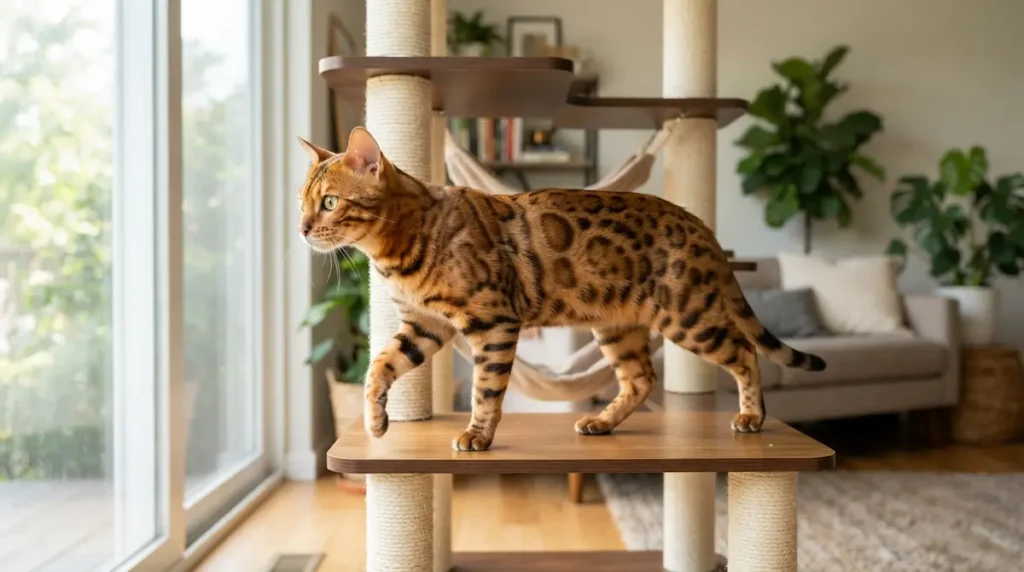
The Bengal is an athletic, short-haired domestic cat breed with a leopard-like spotted or marbled coat, created in the US by crossing domestic cats with the wild Asian leopard cat; pet Bengals today are many generations removed from that wild ancestor. Most weigh 6 to 18 pounds and live 12 to 16 years. A Bengal suits active owners who want a playful, dog-like, trainable cat. It is a poor fit if you want a calm lap cat or can’t offer an hour of play and climbing space every day.
- 💰 Price: about $1,500 to $3,000 for a pet kitten; snow and show cats cost more
- ⚡ Energy: very high; needs daily play, climbing and puzzles
- 🩺 Health watch: HCM, PK deficiency and PRA-b (DNA tests exist for the last two)
- ⚖️ Legal note: banned in Hawaii, Connecticut and New York City; some states limit early generations
Bengal cat quick facts
The Bengal is a TICA-recognized breed known for its rosetted coat, glittering fur, muscular build and very high energy. Sources for each figure are listed at the end of this guide.
- Origin
- United States; first crossed by Jean Mill in 1963
- Breed group
- Medium to large shorthair, athletic build
- Height
- About 13 to 16 inches
- Adult weight
- Males about 10 to 15 lb (up to 18) · females about 6 to 12 lb
- Lifespan
- 12 to 16 years
- Coat
- Short, dense, plush; many have a “glitter” sheen
- Patterns
- Spotted (often rosetted) or marbled
- Colors
- Brown, silver, snow, charcoal, blue, black (melanistic)
- Eyes
- Gold, green or hazel; blue in lynx-point snows
- Energy
- Very high
- Shedding
- Low; brush weekly
- Hypoallergenic
- No (no cat is)
- Recognition
- TICA championship since 1991; not shown in CFA
- Loves water?
- Many do; dripping taps and fountains are favorites
Is a Bengal cat right for me? Quick lifestyle quiz
A Bengal is right for you if you can give it daily active play, vertical space and attention; it is the wrong choice for a quiet home that wants a sleepy cat. Answer four questions for a quick read.
🐱 Bengal fit check
Bengal cat breed scorecard
On our 1 to 5 scale, the Bengal scores top marks for energy, intelligence and playfulness, and lowest for lap-cat calm and suitability for long hours alone. These are editorial ratings by Dr. Usama based on the sources below; individual cats vary.
- EnergyOne of the most active breeds; climbs, leaps and races daily. 5/5
- IntelligenceLearns tricks, fetch and how to open doors and cupboards. 5/5
- PlayfulnessStays kitten-like for years. 5/5
- AffectionBonds closely and follows you around, but on its own terms. 4/5
- Lap-cat calmRarely sits still on a lap for long. 1/5
- VocalChatty; will “talk” to ask for play or food. 4/5
- Grooming needShort coat; a weekly brush is enough. 1/5
- Kid-friendlyGreat with active, respectful kids who play. 4/5
- Can be left aloneBored Bengals get destructive; many do better in pairs. 2/5
- First-time owner fitRewarding but demanding; easier for experienced owners. 2/5
Bengal cat personality and temperament
Bengals are confident, curious, athletic and vocal cats that bond strongly with their family and want to be part of everything you do. They are often described as dog-like: many learn to fetch, walk on a harness and come when called.
A Bengal’s energy is the trait owners underestimate most. They climb to the highest point in a room, open drawers, chase anything that moves and invent games if you don’t provide them. Many are fascinated by water and will paw at dripping taps, join you near the bath or play in their water bowl. Without enough play and puzzles, a bored Bengal may scratch furniture, knock things over or become pushy for attention.
Are Bengal cats aggressive?
Modern pet Bengals are not aggressive by nature; they are domestic cats bred from many generations of Bengal-to-Bengal matings. What looks like aggression is usually rough play or frustration from too little exercise. Use wand toys instead of hands, and give two or more real play sessions a day.
Are Bengals good with kids and other pets?
Bengals are usually great with active, respectful children and cat-friendly dogs, and many enjoy another playful cat for company. Keep small pets such as birds, hamsters and fish secure, because Bengals have a strong hunting drive. See our guide to introducing a cat to a dog.
How much is a Bengal cat?
A pet-quality Bengal kitten from a reputable US breeder costs about $1,500 to $3,000 in 2026, with an average around $2,000. Snow Bengals, rare colors and show-quality kittens cost more, and early-generation F1 and F2 cats can exceed $20,000.
| Type of Bengal | Typical US price | Source |
|---|---|---|
| Pet-quality kitten (registered breeder) | $1,500–$3,000 | Petful 2026; Catster |
| Snow Bengal (lynx, mink or sepia) | $2,000–$4,000 | Petful 2026 |
| Show-quality or rare color | $3,500–$6,000 | Petful 2026 |
| Early generation (F1, F2) | Can exceed $20,000 | Petful 2026 |
| Adoption or rescue | About $300–$500 | Spot Pet Insurance |
| Food (monthly, high-protein) | About $40–$80 | A-Z Animals |
Bengal cat size: how big do Bengals get?
Adult male Bengals usually weigh about 10 to 15 pounds and can reach 18, while females usually weigh about 6 to 12 pounds; most stand 13 to 16 inches tall. They look bigger than their weight because they are long, lean and very muscular.
When is a Bengal fully grown?
Bengals do most of their growing in the first year, then keep filling out with muscle for a while after that, especially males. Feed kitten food through the first year, and judge portions by body shape: you should feel ribs easily under a thin layer of muscle.
Bengal vs a regular cat: a large male Bengal is usually bigger and much more muscular than an average house cat, but Bengals are not giant cats. For a truly big breed, see our Maine Coon guide.
Bengal cat colors and patterns
Bengals come in two patterns, spotted (often with two-toned rosettes) and marbled, in colors including brown, silver, snow, charcoal, blue and solid black (melanistic). Brown is the classic and most common color; snow and silver are the most searched.
- Brown
- Silver
- Snow
- Charcoal
- Blue
- Black (melanistic)
| Color | What it looks like | Eyes |
|---|---|---|
| Brown | Golden, orange or tan background with black to brown spots; the classic “leopard” look | Gold, green or hazel |
| Silver | Pale silver-white background with crisp black or gray markings | Gold, green or hazel |
| Snow (lynx, mink, sepia) | Ivory or cream background with pale to dark markings; seal lynx point is the palest | Blue in lynx point; aqua or gold in mink and sepia |
| Charcoal | Darker background with a dark facial “mask” and cape along the back | Gold or green |
| Blue | Pale peach-gray background with gray-blue markings | Gold or green |
| Black (melanistic) | Solid black with faint “ghost” spots visible in sunlight | Gold or green |
“Orange” and “grey” Bengals are everyday names for a warm brown Bengal and a silver Bengal. “White” Bengals are usually snows. Some Bengals carry a long-hair gene and are called Cashmere Bengals, which not all registries accept.
Bengal generations explained: F1, F2, F3, F4 and SBT
The “F” number tells you how many generations a Bengal is from its wild Asian leopard cat ancestor: F1 has a wild parent, while F4 and later cats are treated as domestic. Almost all pet Bengals sold today are SBT (Stud Book Tradition) cats, many generations removed.
| Generation | Wild ancestor | What it means for owners |
|---|---|---|
| F1 | One parent is an Asian leopard cat | Hybrid; males are sterile; not a typical pet; illegal or regulated in many places |
| F2 and F3 | Wild grandparent or great-grandparent | Still hybrids; males may have fertility problems; regulated in several states |
| F4 | Four generations back | Considered domestic by registries; legal in most states |
| F5 and SBT | Five or more generations back | Domestic pet Bengal; the type almost all families buy |
Are Bengal cats legal? Where Bengals are banned in the US
Bengal cats are legal in most of the US, but Hawaii and Connecticut ban them, New York City and Seattle prohibit them at city level, and several states regulate early generations (F1 to F4). Laws change, so check your state and city rules before buying.
| Place | Rule (as reported in 2026) |
|---|---|
| Hawaii | All Bengals prohibited |
| Connecticut | All generations prohibited |
| New York City | Prohibited, though New York State allows F5 and later registered cats |
| Seattle, WA | Restricted at city level |
| Delaware | Permit required |
| Alaska | At least four generations from a wild cat, with pedigree and permit |
| Georgia, Massachusetts, Indiana | Early generations regulated |
| Denver, CO | Limits on ownership |
Bengal cat health problems and lifespan
Bengals are generally healthy, but known breed concerns include hypertrophic cardiomyopathy (HCM), pyruvate kinase deficiency (PK-def), progressive retinal atrophy (PRA-b), flat-chested kitten syndrome, patellar luxation and hip dysplasia. Good breeders DNA-test for PK-def and PRA-b and heart-scan breeding cats.
| Condition | What it is | Screening |
|---|---|---|
| Hypertrophic cardiomyopathy (HCM) | Thickening of the heart muscle | No DNA test; yearly heart ultrasound (echocardiogram) for breeding cats |
| Pyruvate kinase deficiency (PK-def) | Inherited red blood cell defect causing anemia | DNA test available |
| Progressive retinal atrophy (PRA-b) | Inherited loss of vision | DNA test available |
| Flat-chested kitten syndrome | Chest deformity in young kittens | Seen at birth; affected cats should not be bred |
| Patellar luxation, hip dysplasia | Kneecap slipping; hip joint problems | Vet exam; X-rays if lame |
| Diarrhea from parasites | Giardia and Tritrichomonas foetus | Testing if diarrhea doesn’t resolve |
Chewy’s vet-reviewed breed guide also notes that intestinal lymphoma appears more often in Bengals, so ongoing diarrhea or weight loss in an adult Bengal deserves a vet visit. A cat DNA test such as Basepaws can screen many genetic markers; compare options in our best cat DNA tests guide. For quick questions between vet visits, Dutch offers video calls with licensed US vets.
How long do Bengal cats live?
Bengal cats usually live 12 to 16 years, and some live longer with good care. Indoor living, a lean body, dental care and heart checks give your cat the best chance at a long life.
Are Bengal cats hypoallergenic?
No, Bengals are not hypoallergenic. Their short, low-shedding coat may spread less hair, but cat allergens come from saliva and skin. Spend time with the cat before committing, and see our cat breeds for people with allergies.
Bengal cat care: food, grooming and exercise
Food
Feed a Bengal a complete, high-protein diet in measured meals, because an active cat still gains weight if it is overfed or under-exercised. Puzzle feeders turn meals into a hunt, and an automatic cat feeder keeps small, regular meals on schedule. Use our cat feeding calculator for a starting portion.
Grooming
Brush a Bengal once a week; the short, pelt-like coat sheds little and rarely mats. Trim nails every few weeks, brush teeth, and check ears.
Exercise and enrichment
A Bengal needs at least two vigorous play sessions a day, plus climbing space and puzzles. Fetch, wand toys, harness walks and clicker training all work. For ideas, see our indoor cat enrichment ideas and how to exercise a cat at home.
Water
Many Bengals love moving water, so a fountain both entertains them and helps them drink more. This Petlibro stainless steel fountain is sturdy and easy to clean; compare more in our cat water fountain guide.
Best toys and home setup for a Bengal cat
The best toys for Bengal cats let them stalk, chase, climb and solve problems: wand toys, tunnels, puzzle feeders, sturdy tall trees and wall-mounted climbing or scratching spots. Rotate toys weekly so they stay exciting.
- 🎣 Wand toys: the best daily workout; end each session with a “catch” and a treat
- 🛑 Crinkle tunnel: ambush spot and racetrack in one, like this cat tunnel
- 🧗 Tall, heavy cat tree: Bengals launch themselves at trees, so choose a stable one; see our best cat trees for large cats
- ⛰️ Wall scratchers and shelves: vertical territory without floor space, such as wall scratcher pads
- 🌱 Cat grass: a safe plant to chew, like this cat grass grow kit
- 🧩 Puzzle feeders: work the brain and slow fast eaters
Store wand toys away after play; string and feathers can be swallowed.
Bengal vs tabby, Savannah, Egyptian Mau and Ocicat
A Bengal differs from a regular spotted tabby by its rosettes, glittering pelt-like coat and muscular, athletic build; a Savannah is much taller and descends from the African serval.
| Trait | Bengal | Spotted tabby | Savannah | Egyptian Mau | Ocicat |
|---|---|---|---|---|---|
| Wild ancestor | Asian leopard cat | None | African serval | None | None |
| Markings | Rosettes or marble, high contrast | Simple spots or stripes, “M” on forehead | Bold solid spots | Random spots | Thumbprint spots |
| Coat feel | Pelt-like, often glittered | Ordinary | Coarser | Silky | Satin |
| Size | Medium to large, muscular | Varies | Tall and leggy | Medium | Medium to large |
| Energy | Very high | Varies | Very high | High | High |
Is my tabby part Bengal? Rosettes (spots with a lighter center), a glitter sheen and a strong, long-legged body are clues, but only a DNA test can tell. Shelter “Bengal mixes” are often spotted tabbies.
Bengal cat history
Breeder Jean Mill first crossed a domestic cat with an Asian leopard cat in 1963, and the Bengal was developed into a stable breed through the 1980s. Other breeds used along the way included the Egyptian Mau, Abyssinian, Burmese, Ocicat and American Shorthair. TICA accepted the Bengal for championship status in 1991. Today, pet Bengals are bred Bengal to Bengal, with no wild cats involved.
Where to get a Bengal cat: buying or adopting safely
Buy a Bengal only from a TICA-registered breeder who shows DNA results for PK-def and PRA-b and heart screening for the parents, or adopt from a Bengal rescue.
- Check legality first: confirm Bengals (and the generation) are allowed where you live.
- Ask for papers: TICA registration and the kitten’s generation (SBT for a family pet).
- Ask for health results: PK-def and PRA-b DNA tests and recent heart scans for both parents.
- Meet them: visit or video call, meet the mother, and see how kittens are raised.
- Wait for the right age: good breeders place kittens at about 12 to 13 weeks.
- Read the contract: health guarantee, spay/neuter terms and a take-back promise.
- Consider rescue: search Petfinder and regional Bengal rescues; adult Bengals often need new homes because owners underestimated their energy.
- Some Bengals have a “glitter” coat: the hair tips shimmer like they are dusted with gold.
- Rosettes on a Bengal are two-toned spots, like those of a leopard or jaguar.
- F1 Bengal males are sterile, which is one reason breeders work with later generations.
- Many Bengals happily play in water, unlike most cats.
Frequently asked questions
How much does a Bengal cat cost?
A pet-quality Bengal kitten costs about $1,500 to $3,000 from a reputable US breeder in 2026, with an average around $2,000. Snow and show-quality kittens cost more, and adoption is usually about $300 to $500.
How long do Bengal cats live?
Bengal cats usually live 12 to 16 years. Indoor living, a healthy weight and regular vet checks help them reach the upper end.
Are Bengal cats hypoallergenic?
No, Bengal cats are not hypoallergenic, because cat allergens come from saliva and skin, not just hair. Their low-shedding coat may help some people a little.
Why are Bengal cats illegal in some places?
Some places restrict Bengals because the breed descends from the wild Asian leopard cat, and early generations are treated as hybrids. Hawaii and Connecticut ban them, and New York City prohibits them; most states allow later-generation Bengals.
How big do Bengal cats get?
Male Bengals usually weigh 10 to 15 pounds (up to 18) and females 6 to 12 pounds. They are muscular rather than giant.
Are Bengal cats affectionate?
Yes, Bengals are affectionate and loyal, but they show it by following you, playing and “talking” rather than sitting on your lap for long.
Do Bengal cats like water?
Many Bengals do like water, playing with dripping taps, water bowls and fountains. A pet fountain is a safe way to let them enjoy it.
Can Bengal cats be left alone?
Bengals can handle a normal workday alone if they get vigorous play before and after, puzzle toys and climbing space; many do better with a second playful cat. Long, empty days often lead to boredom and destructive behavior.
- GCCF, Bengal breed profile (size, colors, generations, health)
- Purina, Bengal
- Cats.com, Bengal cat breed information
- Chewy, Bengal cat
- VCA Animal Hospitals, Bengal
- Petful, Bengal cat price and lifetime cost (2026) and Where are Bengal cats illegal?
- Catster, Bengal cat price and Are Bengal cats illegal in some states?
- Spot Pet Insurance, How much will a Bengal cost?; A-Z Animals, Bengal cat prices
This guide is for education and does not replace a vet exam or legal advice. Prices and laws change; we review this page regularly.
Dr. Usama is a registered veterinarian (Pakistan Veterinary Medical Council license no. 9472). He earned his Doctor of Veterinary Medicine at The Islamia University of Bahawalpur and an MPhil in Zoology from the Virtual University of Pakistan, with research work at Bahauddin Zakariya University, Multan and the University of Veterinary and Animal Sciences, Lahore. He reviews every health and safety point on Happy Cat At Home and writes for US cat owners who want practical, honest advice. More about Dr. Usama · Editorial policy
Join the Happy Cat Club: one short, vet-reviewed email a week with breed guides, care tips, honest product picks and seasonal safety alerts. No spam, unsubscribe anytime.