Where Should I Put My Cat Litter Box? 10 Rules, Best Rooms & Placement Scorecard (2026)

Registered Veterinary Medical Practitioner, PVMC license no. 9472
Updated November 12, 2026 · Sources listed at the end
Where should I put my cat’s litter box?
Put the litter box in a quiet, low-traffic spot your cat can reach at any time, with a clear view and an easy way out, away from food, water and noisy appliances. A quiet bathroom (with the door kept open), spare room or bedroom corner usually works well.
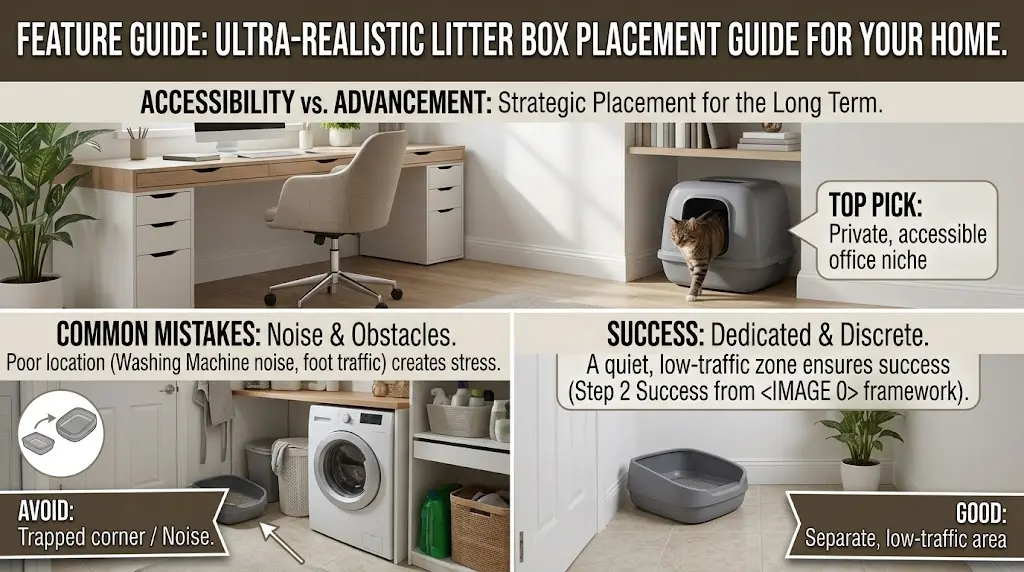
Avoid: rooms with doors that close, spots beside the washer or dryer, dark dead-end closets, garages and balconies. With more than one cat, use one box per cat plus one, spread across different rooms or floors.
3 litter boxes for the right location
Near living areas or in an apartment: the Oneisall self-cleaning box & pet air purifier set pairs an automatic box with an air purifier for small spaces.
Quiet corner, manual box: the Meowant stainless steel box (LB02) is large and high-sided, and steel doesn’t hold odors like scratched plastic.
Senior cats: the Oneisall Ease S1 is a self-cleaning box with an entry step, so older cats don’t have to climb as high.
See Oneisall + Purifier → See Meowant Steel Box → See Oneisall Ease S1 →
Affiliate links. Check prices and box sizes on the brand site; see our litter box size guide.
- 1. 10 rules for litter box placement
- 2. Best and worst rooms
- 3. Where to put a self-cleaning litter box
- 4. Apartments and studios
- 5. Multi-cat and multi-story homes
- 6. Kittens, seniors and new cats
- 7. Placement scorecard
- 8. How to move a litter box
- 9. Common placement mistakes
- 10. When it’s not the location
- 11. FAQs
Cats are vulnerable while they toilet, so they choose spots that feel safe, quiet and clean. A box hidden where it suits people, such as beside the washer, in a closet or in a cold basement, can lead to accidents, holding urine, or stress-related bladder problems. Use the rules below to pick the spot your cat will actually use.
1. 10 rules for litter box placement
1. Your cat can reach it 24/7
Never put the only box behind a door that might close. Use a door stop, strap or pet door for bathrooms and bedrooms.
2. Keep it away from loud appliances
Washers, dryers, furnaces and loud fridges can startle a cat mid-use and make it avoid the box.
3. Give a clear view and a way out
Cats feel exposed when toileting. Avoid dead-end hallways and tight spaces where another pet or a child could corner them.
4. Keep it away from food and water
Put food and water in a clearly separate area, ideally a different room.
5. One box per cat, plus one
Spread boxes across different rooms or floors. Several boxes in one spot count as one location.
6. Choose a quiet, low-traffic spot
Private but not hidden away: a spare room, office corner or quiet bathroom is better than a busy entryway.
7. Good airflow, stable temperature
Avoid sealed closets, damp basements and spots right under heating or AC vents.
8. Easy for you to scoop
If it’s hard to reach, you’ll scoop less often, and a dirty box is a top cause of accidents.
9. Easy for seniors and kittens
Older cats with stiff joints and small kittens need boxes on the floor they live on, with a low entry.
10. Move it gradually
Sudden moves confuse cats. Add a box in the new spot first, then remove the old one once the new one is used.
2. Best and worst rooms for a litter box
| Location | Pros | Cons | Verdict |
|---|---|---|---|
| Bathroom | Easy-clean floor, easy disposal | Door often closed; small space | Good if the door stays open |
| Spare room or bedroom | Quiet, low traffic | Litter tracking on carpet | Very good |
| Living room corner | Easy to reach, good escape routes | Busy at times | Good in a quiet corner |
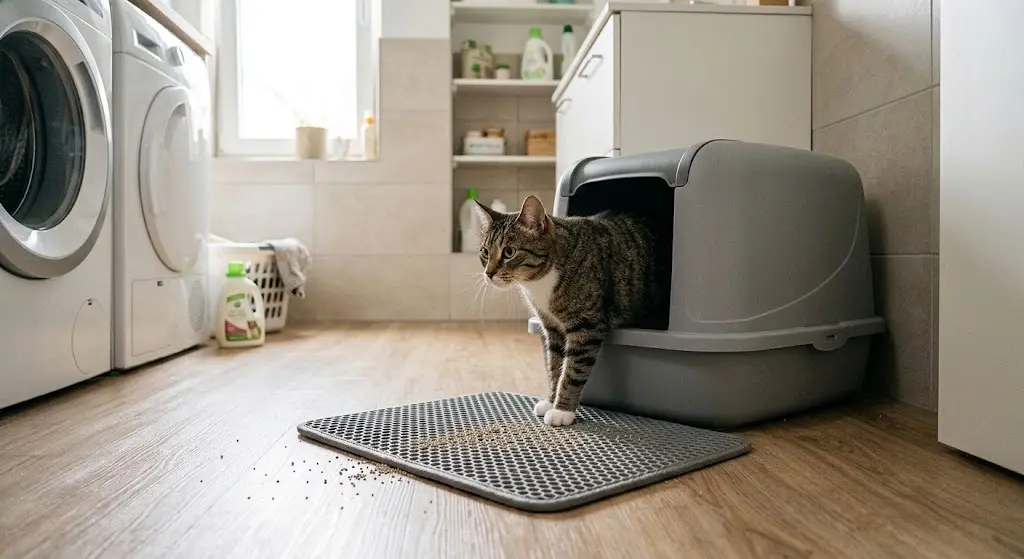
| Laundry room | Hard floor, out of sight | Machine noise, vibration, detergent smells | Only if your cat isn’t bothered |
| Closet | Hidden, contains litter | Poor airflow, can feel like a trap | Avoid unless open and roomy |
| Basement | Private, spacious | Stairs, cold, dark | Fine as an extra box, not the only one |
| Garage or balcony | Keeps odor outside | Temperature extremes, fumes, can get shut out | Avoid |
3. Where to put a self-cleaning litter box
Placement matters even more with an automatic box, because a motor running in a busy hallway can scare a nervous cat away. Pick a quiet corner and a low-noise model. Our guide to the quietest self-cleaning litter boxes compares noise levels.
- Near a power outlet, so the cord isn’t stretched across a walkway.
- On a flat, hard floor: many automatic boxes need a level surface for their sensors and weighing to work properly.
- With clearance around and above the box so lids and drawers open fully.
- Keep a regular box nearby for the first couple of weeks while your cat gets used to it.
- Away from food and water, like any litter box.
🧹 Compare Self-Cleaning Litter Boxes →
4. Where to put a litter box in an apartment or studio
In a small space, put the box as far from the kitchen and eating area as you can, in a corner your cat can always reach.
- Bathroom nook: along a wall you don’t walk past, with the door wedged or strapped open.
- Bedroom corner: away from the bed’s head, with a litter mat and an unscented, low-dust litter.
- Living area furniture enclosure: only if it’s roomy inside and has an easy way in and out.
An open-top box with high back walls keeps litter in without trapping odor. For big cats in multi-cat apartments, the CATLINK Scooper Open-X is an open-top self-cleaning option (affiliate link).
5. Multi-cat and multi-story homes
- Spread boxes out so one cat can’t guard every box from another.
- Don’t line boxes up in one spot; cats see that as one location.
- Put a box on every floor your cats use, especially for older cats.
- Avoid boxes in narrow corridors where one cat can block another.
If cats are fighting over boxes, see how to stop cat aggression toward other cats.
6. Kittens, seniors and newly adopted cats
- Kittens: keep a small, low box close to where the kitten plays and sleeps, then add boxes as it explores more of the home. See how to litter train a cat.
- Senior cats: a low-entry box on the main floor, close to their favorite resting spot, with good lighting at night.
- New cats: start in one quiet room with food, water, bed and litter box at opposite sides, then expand.
7. Litter box location scorecard (18 points)
Score your current spot: add the points for every “yes”.
| Question | Points if yes |
|---|---|
| Your cat can reach it at any time (no closing doors) | 2 |
| Away from loud appliances | 2 |
| In a separate area from food and water | 2 |
| Your cat can see who is coming | 2 |
| There is a clear way out | 2 |
| Quiet, low foot traffic | 2 |
| You can scoop it easily every day | 2 |
| Stable temperature, no drafts or hot vents | 2 |
| Hard, level, easy-to-clean floor | 1 |
| Some light at night | 1 |
- 16 to 18: great spot.
- 12 to 15: good, but fix the “no” answers.
- 8 to 11: plan a move to a better spot.
- Below 8: move it, gradually, as soon as you can.
8. How to move a litter box without accidents
- Short distance (same room): move the box a little each day toward the new spot.
- Different room or floor: set up a second box in the new spot and keep the old one. Once your cat uses the new box reliably for about a week, remove the old one.
- Clean the old spot with an enzyme cleaner if there were any accidents.
9. Common litter box placement mistakes
- Putting the box right beside food and water.
- Putting it next to the washer, dryer or furnace.
- Using a room whose door is often closed.
- Hiding it in a dark, unventilated closet.
- Putting it at the end of a dead-end hallway.
- Lining up all the boxes in one spot.
- Making a senior cat use stairs to reach the only box.
- Letting dogs or children block the entrance.
- Squeezing it under furniture where the cat can’t stand up.
- Putting it in a busy entryway.
- Moving it suddenly across the house.
- Choosing a spot so awkward that you skip scooping.
10. When it’s not the location
If your cat avoids a box that is clean, big enough and well placed, look for a medical cause. Bladder inflammation, crystals, constipation and arthritis can all cause accidents.
For other causes and fixes, see litter box issues with solutions.
11. Frequently asked questions
Where is the best place to put a cat litter box?
The best place is a quiet, low-traffic spot your cat can reach at any time, with a clear view and a way out, away from food, water and noisy appliances. A quiet bathroom, spare room or bedroom corner often works well.
Can I put a cat litter box in the bedroom?
Yes. A quiet bedroom corner works well for many cats, especially in apartments. Scoop at least daily, use a low-dust unscented litter, and keep the door open so your cat can always get in.
How far should a litter box be from food and water?
Keep them in clearly separate areas, ideally in different rooms or at opposite sides of a small apartment. Cats generally prefer not to eat or drink near where they toilet.
Is it okay to put a litter box in the laundry room?
Only if your cat isn’t bothered by the washer and dryer. If machines are loud or start suddenly while your cat is in the box, choose a quieter spot.
Should a litter box be covered or open?
Many cats are happy with open boxes, and studies have found that cats on average don’t strongly prefer either type. Watch your cat: if it avoids a covered box, remove the lid or offer an open one too.
Where should I put litter boxes in a multi-cat home?
Use one box per cat plus one, and spread them across different rooms or floors so one cat can’t block another. Boxes lined up side by side count as one location.
Where should I put a self-cleaning litter box?
Put it in a quiet corner with an outlet, on a flat floor, away from food and busy walkways. Keep a regular box nearby while your cat gets used to it.
Why is my cat peeing next to the litter box?
Peeing right beside the box usually means something about the box itself is wrong, such as it being dirty, too small, hard to climb into or covered. It can also be a sign of bladder pain, so check with your vet.
Can I put a litter box in a closet?
Only if the door is fixed open, the space is ventilated and there is room for your cat to turn around and leave easily. Small, dark or closed closets are best avoided.
- AAFP and ISFM: guidelines for diagnosing and solving house-soiling behavior in cats; feline environmental needs guidelines.
- Cornell Feline Health Center, Cornell University: litter box problems.
- Grigg EK et al. (2013), Journal of Feline Medicine and Surgery: litter box preference (covered vs uncovered boxes) in domestic cats.
Disclosure: Happy Cat At Home is reader-supported; some links are affiliate links and we may earn a commission at no extra cost to you. This guide is educational and does not replace a veterinary exam. How we make money.