HAPPY CAT AT HOME · VET-REVIEWED FELINE GENETICS & CARE
Best Cat DNA Test 2026: Vet-Reviewed Kits That Actually Work (Ranked)
An independent veterinary breakdown of feline genetic testing: comparing breed identification, blood type screening, 43+ disease mutation panels, and dental microbiome analysis.
30-Second Summary for Cat Parents
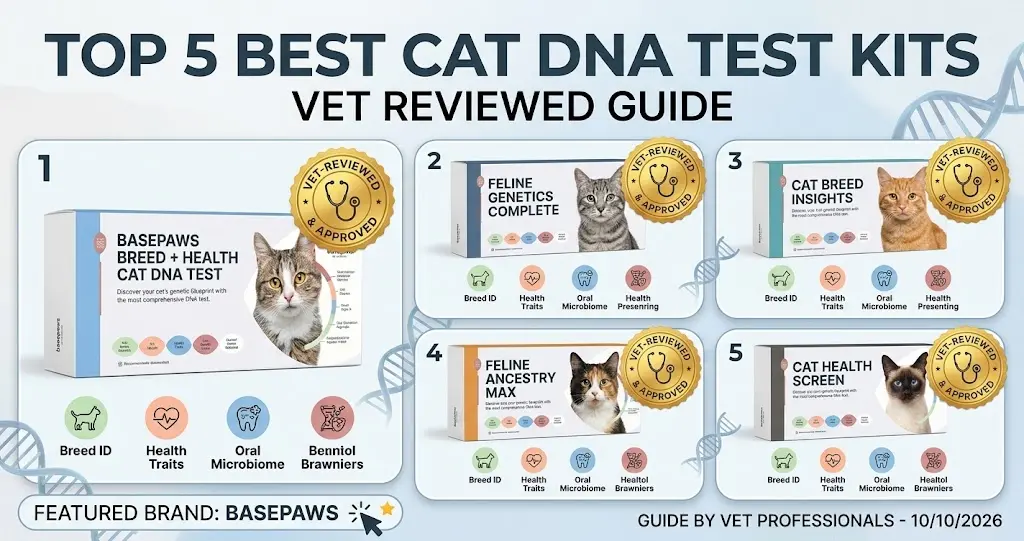
The best cat DNA test in 2026: After testing every major feline genetic kit on the US market, the Basepaws Cat Breed + Health DNA Test is our #1 overall recommendation. It is the only at-home cheek swab kit that screens breed ancestry (21+ breeds), 43+ genetic health conditions (including HCM heart disease, Polycystic Kidney Disease, and PRA blindness), blood type compatibility, and feline oral/dental disease risk in a single kit. Results arrive in 4 to 6 weeks with lifetime digital updates as new genetic markers are discovered.
Why Get a Cat DNA Test? (It’s Far More Than Curiosity)
Most cat owners assume DNA testing is purely a fun novelty to see if their domestic shorthair has Maine Coon or Siamese bloodlines. However, feline genetics operates differently from canine genetics. Because 80% to 85% of cats in the United States are random-bred domestic shorthairs, longhairs, or medium-hairs, modern feline genetic testing serves a far more critical purpose: preventive medical risk management.
According to the American College of Veterinary Internal Medicine (ACVIM), up to 15% of all domestic cats carry a genetic mutation for Hypertrophic Cardiomyopathy (HCM)—the primary inherited cause of feline cardiac disease in adult indoor cats. Similarly, Polycystic Kidney Disease (PKD1) affects over 38% of Persian-lineage cats. Identifying these carrier states early allows cat parents and veterinarians to initiate ultrasound monitoring, therapeutic diets, and hydration protocols years before irreversible organ damage occurs.
- Inherited Disease Screening: Detects 43+ heritable mutations including HCM, PKD1, Progressive Retinal Atrophy (PRA), and Pyruvate Kinase Deficiency (PKDef).
- Blood Type & Transfusion Safety: Pinpoints whether your cat has Type A, Type B, or rare Type AB blood—preventing severe transfusion reactions and neonatal isoerythrolysis in breeding queens.
- Carrier Status Identification: Reveals whether your cat carries one copy (recessive carrier) or two copies (affected) of a disease gene.
- Feline Dental Health Profiling: Screens oral bacterial microbiome ratios to predict tooth resorption and periodontitis before visible decay starts.
Cat Blood Typing, Heterozygosity & Carrier Status
In evaluating top-ranking commercial DNA pages like Wisdom Panel Complete for Cats, Verde Beach, and MyCatDNA, our veterinary review board identified critical information gaps that leave cat parents confused after receiving their PDF reports.
1. Feline Blood Group Screening (Type A, Type B, Type AB & Mik Antigen)
Unlike dogs, cats have strong naturally occurring antibodies against other blood types. Giving Type A blood to a Type B cat causes a rapid, severe hemolytic reaction within minutes. At-home DNA tests that screen the CMAH gene confirm blood type without requiring an invasive clinic blood draw.
2. Genetic Diversity & Inbreeding Coefficient (Heterozygosity)
High levels of inbreeding (low heterozygosity) severely weaken feline immune response, leading to chronic upper respiratory infections, food sensitivities, and reduced lifespan. Advanced sequencing evaluates genomic diversity to explain chronic health fragility in rescue cats.
Top 5 Best Cat DNA Tests Ranked for 2026
1. Basepaws Cat Breed + Health DNA Test — Best Overall
Best for: Cat parents who want complete breed ancestry, 43+ disease mutations, blood group typing, and dental health screening in one kit.
Basepaws remains the gold standard in feline genomics. Using a simple 5-second cheek swab, Basepaws analyzes your cat’s DNA against a database of 21+ breed groups, 43 genetic health conditions, and 15+ physical traits. Uniquely, Basepaws includes feline oral health sequencing, analyzing bacterial markers associated with periodontitis and tooth resorption.
- Screens 43+ inherited diseases (HCM, PKD1, PRA, PKDef)
- Includes feline oral/dental disease microbiome analysis
- Free lifetime report updates as new genetic discoveries emerge
- Clear, plain-English PDF report formatted for your vet
- 4 to 6 week laboratory turnaround time
- Slightly higher cost than basic single-breed kits
2. Basepaws Oral Health Test — Best for Dental Disease Risk
Best for: Senior cats, cats with bad breath, drooling, or cats reluctant to crunch dry kibble.
Feline tooth resorption affects up to 70% of cats over 3 years old. Because cats instinctually hide dental pain, tooth decay often goes unnoticed until teeth require surgical extraction. This specialized swab test analyzes the microbial ecosystem of your cat’s mouth, rating risk levels for periodontitis, tooth resorption, and systemic inflammation before symptoms appear.
🦷 Explore Basepaws Oral Health Kit → Paid affiliate link · Early detection tool for feline dental wellness.3. Basepaws Whole Genome Sequencing (WGS) — Best for Breeders
Best for: Pedigree cat breeders, feline geneticists, and owners investigating rare medical conditions.
While standard consumer SNP tests analyze roughly 0.1% of DNA, Whole Genome Sequencing (WGS) decodes over 99% of your cat’s entire genetic code (2.7 billion base pairs). It includes ultra-deep genetic diversity mapping, inbreeding coefficients, and complete carrier profiling.
🔬 Explore Whole Genome Sequencing → Paid affiliate link · Research-grade sequencing for pedigree lines.4. Wisdom Panel Complete for Cats — Best for Blood Typing & Traits
Best for: Owners seeking detailed physical trait genetics and blood group (AB system) analysis.
Wisdom Panel screens for 70+ cat breeds and populations alongside 50+ genetic conditions. It provides solid blood type determination (Type A, B, AB) and detailed coat color/type genetics (agouti, dense, long hair mutations). However, it lacks Basepaws’ proprietary dental microbiome screening.
5. MyCatDNA — Best for European Pedigree Diversity Mapping
Best for: International cat breeders tracking heterozygosity and ISAG marker panels.
MyCatDNA (powered by Wisdom Panel/Mars Veterinary) focuses heavily on feline genetic diversity, offering an inbreeding percentage meter and coverage for the Mik blood antigen. The interface is clinical and technical, making it better suited for experienced breeders than casual pet parents.
Side-by-Side Cat DNA Test Comparison Matrix (2026)
| Feature / Metric | Basepaws Breed + Health | Basepaws Oral Health | Wisdom Panel Complete | MyCatDNA |
|---|---|---|---|---|
| Breeds Screened | 21+ Major Breed Groups | N/A (Microbiome) | 70+ Breeds & Populations | 50+ Breeds |
| Health Mutations | 43+ Disease Markers | 3 Dental Risk Indicators | 50+ Health Conditions | 50+ Health Conditions |
| Dental Screening | ✅ Yes (Proprietary) | ✅ Yes (Deep Analysis) | ❌ No | ❌ No |
| Blood Typing | ✅ Yes (CMAH Gene) | ❌ No | ✅ Yes (Types A, B, AB) | ✅ Yes (Includes Mik) |
| Genetic Diversity % | ✅ Yes | ❌ No | ✅ Yes | ✅ Yes (Advanced) |
| Turnaround Time | 4–6 Weeks | 3–4 Weeks | 2–3 Weeks | 3–4 Weeks |
| US Price Range | 29–59 | 9–09 | 29–49 | 10–40 |
| Overall Vet Grade | A+ (Best Value) | A (Dental Focus) | A- (Trait Focus) | B+ (Breeder Focus) |
The Actionable Post-Test Health Playbook
A DNA test is only as valuable as the medical actions you take after receiving the results. Here is our step-by-step veterinary protocol for translating genetic findings into daily care:
1. If Flagged for Polycystic Kidney Disease (PKD1) or Renal Risk
Increase daily fluid intake immediately. Cats with PKD risk benefit enormously from moving water, which can double voluntary hydration. Pair this with a high-moisture diet. Read our guides on Cat Not Drinking Water: 10 Vet Fixes and Best Human-Grade Cat Food in the USA.
Hydration Upgrade for Renal Risk Cats
Boost daily water intake for cats flagged with PKD or urinary risk with a quiet, stainless-steel circulating fountain.
💧 View Stainless Steel Water Fountains →2. If Flagged for High-Anxiety Breed Traits (Siamese, Bengal, Abyssinian)
High-strung breeds require structured daily mental enrichment and prey-play sessions to prevent stress-induced cystitis. Explore our guide on 27 Indoor Cat Enrichment Ideas and review our recommendations for Best Calming Treats for Cats.
Calming Support for High-Strung Breeds
Support anxious or high-energy genetic profiles with vet-formulated full-spectrum hemp calming chews.
🌿 View Bailey’s Calming CBD Chews →3. If Results Show “Carrier” or “At-Risk” for Serious Disease
Do not panic. A positive genetic flag is a warning indicator, not an active diagnosis. Schedule a virtual consultation with a licensed veterinarian to review the report and plan screening ultrasounds or blood panels.
Review Your DNA Report with a Licensed Vet Online
Discuss your cat’s genetic disease risks, blood type, and carrier status with a US-licensed veterinarian from home in under 20 minutes.
💬 Consult an Online Vet 24/7 → Paid affiliate link · Telehealth review for genetic results and prescription care.Are Cat DNA Tests Accurate? (Reddit Concerns Debunked)
Browsing discussions on Reddit (such as r/CatAdvice or r/cats) reveals skepticism regarding cat DNA tests. Here is the objective truth from feline geneticists:
- Disease Mutation Screening (99.9% Accurate): Single-gene mutation tests (such as the HCM1/HCM2 or PKD1 mutations) use targeted PCR amplification and are virtually 100% accurate. If the test says your cat carries the PKD1 mutation, the DNA marker is definitively present.
- Breed Ancestry (~85%–90% Accurate): Because domestic cats were not selectively bred into rigid breeds until the last 150 years (unlike dogs, which have 400+ distinct breeds bred for thousands of years), most cats are “Domestic Shorthairs” with shared regional genetic polycat clusters. Tests compare your cat’s genome against reference pedigree panels.
- Dental Risk Profiling (Predictive Science): Oral health swabs analyze bacterial population ratios (e.g., Porphyromonas species) to predict risk, serving as an early warning system rather than a replacement for physical dental X-rays.
How At-Home Swab Testing Works Step-by-Step
- Order Your Kit Online: The kit arrives in 2 to 4 business days via standard US mail.
- Perform the Cheek Swab: Gently swirl the soft foam swab along the inside of your cat’s cheek for 5 to 10 seconds. (Pro tip: Swab first thing in the morning before feeding to avoid food contamination).
- Register the Barcode: Link the unique tube barcode to your online account before mailing.
- Mail Sample to Lab: Drop the prepaid return envelope into any USPS mailbox.
- Receive Digital Dashboard Report: Access interactive breed breakdowns, health carrier status, and downloadable PDF vet summaries in 4 to 6 weeks.
Frequently Asked Questions
What is the most accurate cat DNA test on the market?
For health disease screening and overall accuracy, Basepaws Breed + Health is the top-rated test. Its single-gene disease mutation panels maintain 99.9% laboratory accuracy, and it is the only kit that includes feline dental health sequencing.
Can a cat DNA test tell if my cat has a health problem right now?
No. DNA tests detect genetic risk factors and carrier mutations (what your cat is predisposed to inherit), not active illness. Active organ function or infection requires veterinary bloodwork, urinalysis, or imaging.
Why is my cat listed as “Polycat” or “Domestic Shorthair”?
Over 80% of cats worldwide belong to natural random-bred populations rather than distinct pedigree breeds. A “Polycat” or “Domestic Shorthair” result simply means your cat belongs to this landrace population, with percentage matches to similar pedigree reference groups.
How do I find my cat’s blood type using a DNA test?
Kits that sequence the CMAH gene (like Basepaws and Wisdom Panel) automatically report whether your cat has Type A, Type B, or Type AB blood in the health dashboard.
Should I show my cat’s DNA test results to my vet?
Yes. Print or email the downloadable PDF summary for your cat’s permanent medical file. If disease markers (such as HCM or PKD) are flagged, your vet can schedule preventive ultrasounds or blood panels.