Home › Cat Breeds › Russian Blue
Disclosure: Happy Cat At Home is reader-supported. A few links below are affiliate links, so we may earn a commission at no extra cost to you. No breeder or brand paid for placement.
Russian Blue Cat: Personality, Price, Lifespan and Breed Facts (Vet-Reviewed)
 Written & medically reviewed by Dr. Muhammad Usama, DVM, RVMP· PVMC license no. 9472

OriginRussia (believed)
Height9–11 inches
Adult weight7–16 lb (males larger)
Life span10–20 years
What is a Russian Blue cat?
The Russian Blue is a medium-sized, short-haired cat breed with a dense, silver-tipped blue-gray double coat, vivid green eyes and a gentle, reserved personality; most weigh 7 to 16 pounds and live 15 years or more. It suits quiet homes, apartments and owners who want a loyal cat that bonds closely with its family. It is a poor fit for very busy, noisy homes, and despite its reputation it is not truly hypoallergenic.
- 🔍 How to spot one: blue coat only, green eyes, mauve paw pads, no white patches
- ❤️ Personality: shy with strangers, devoted to “its” people, loves routine
- 🩺 Health watch: overeating and obesity; one study found a higher diabetes risk
- 💰 Price: about $500 to $1,500 for a pet kitten; adoption about $75 to $200
Is my gray cat a Russian Blue? How to tell
A purebred Russian Blue has three hallmarks: an even blue coat with silver-tipped hairs, bright green eyes, and mauve or lavender paw pads. Most gray cats in shelters are domestic shorthairs that share the color but not the breed. A cat with any white patch, a long coat, or copper eyes as an adult is not a show-standard Russian Blue.
🔍 Russian Blue look checker
Tick every trait your cat has. This checks looks only; only pedigree papers or a DNA test can confirm breed.
Want a real answer? A cat DNA test such as Basepaws compares your cat’s DNA with breed groups and also screens health markers. Compare options in our best cat DNA tests guide.
“Russian Blue vs gray cat”: “gray cat” is just a color, while Russian Blue is a breed with a written standard. A domestic gray cat can have any eye color, a thinner single coat, white markings and a rounder body.
Russian Blue quick facts
The Russian Blue is a naturally occurring breed recognized by every major registry, known for its plush blue coat, green eyes and quiet, loyal nature. Sources for each figure are listed at the end of this guide.
- Origin
- Believed to be northern Russia (Archangel Isles); exact origin unknown
- Breed group
- Medium shorthair, slim “semi-foreign” body
- Height
- About 9 to 11 inches at the shoulder
- Adult weight
- Males about 10 to 12 lb · females about 7 to 10 lb (range 7 to 16)
- Lifespan
- Often 15 to 20 years; some sources give 10 to 16
- Coat
- Short, dense, fine, plush double coat
- Color
- Blue (gray) with silver tips; CFA accepts blue only
- Eyes
- Vivid green in adults; yellow with green rims in kittens
- Shedding
- Low to moderate; comb weekly
- Temperament
- Gentle, quiet, loyal, shy with strangers
- Good with kids and pets
- Yes with calm, respectful kids and cat-friendly pets
- Hypoallergenic
- No cat is; some allergic owners react less (see below)
- Registries
- CFA (since 1949), TICA, ACFA, FIFe, WCF
- Other names
- Archangel Cat, Archangel Blue
Russian Blue breed scorecard
On our 1 to 5 scale, the Russian Blue scores highest for intelligence and low grooming effort, and lowest for comfort with strangers and noisy homes. These are editorial ratings by Dr. Usama based on the sources below; individual cats vary.
- AffectionVery loyal to its family, often attaches to one person; reserved with others. 4/5
- PlayfulnessStays playful into adulthood; many enjoy fetch and feather wands. 4/5
- Activity levelAgile climber, but calm indoors once played with. 3/5
- IntelligenceLearns routines and house rules quickly; enjoys puzzle feeders. 5/5
- Grooming needShort coat that rarely mats; a weekly comb is enough. 1/5
- SheddingDense coat but not constant shedding. 2/5
- VocalSoft-voiced; some “talk” to their favorite person. 2/5
- Kid-friendlyGood with calm, older kids; stressed by chasing and loud play. 3/5
- Comfort with strangersOften hides from visitors at first; warms up slowly. 2/5
- Inherited health riskNo common breed-specific genetic disease; weight and diabetes are the watch points. 2/5
Is a Russian Blue right for you? Good fit vs not a good fit
A Russian Blue is right for you if you want a gentle, low-maintenance and loyal cat for a calm, predictable home.
- Live in an apartment or a quiet house
- Want a short-haired cat with very easy grooming
- Keep a regular daily routine
- Are a first-time owner who wants a polite, trainable cat
- Want a cat that bonds deeply with one or two people
- Host guests often or have a loud, busy household
- Have toddlers who chase and grab pets
- Need a truly allergy-free cat
- Free-feed and can’t control portions
- Want a cat that loves every stranger
Russian Blue personality and temperament
Russian Blues are gentle, intelligent and quietly affectionate cats that are devoted to their family but often shy and watchful with strangers. They like to size up a new person or situation before joining in, which some people mistake for aloofness.
Most Russian Blues love routine. They expect meals, play and bedtime at the same times, and sudden changes, new furniture or a house full of visitors can stress them. Many follow their favorite person from room to room, and owners often describe them as sensitive to their people’s moods. They stay playful as adults, and many learn to fetch.
Are Russian Blues cuddly lap cats?
Many Russian Blues enjoy sitting on or next to their chosen person, but they like affection on their own terms. Expect a cat that comes to you for cuddles at quiet times rather than one that tolerates handling by everyone.
Are Russian Blues good with kids and other pets?
Russian Blues are generally gentle with respectful children and get along with cat-friendly dogs and cats. They do best with older kids who let the cat approach first. Introduce new pets slowly; our guide to introducing a cat to a dog shows how.
Can Russian Blues be left alone?
Adult Russian Blues usually cope with a normal workday alone, as long as their routine stays predictable and they get play when you’re home. Leave a window perch and puzzle toys; see how long you can leave a cat alone.
Are Russian Blue cats hypoallergenic?
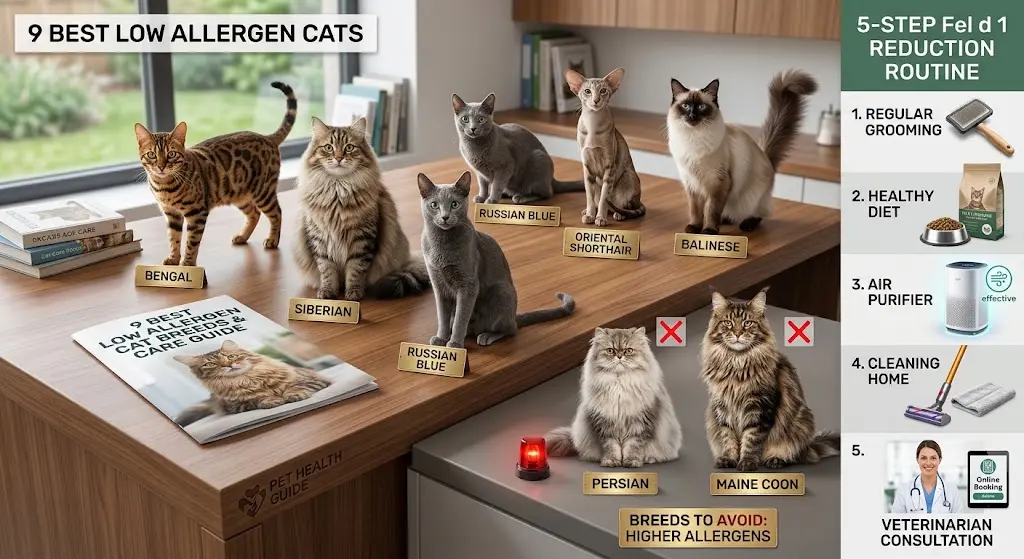
No cat breed is truly hypoallergenic, including the Russian Blue, because cat allergens come mainly from saliva and skin, not hair. Some breed sources, including Hill’s, say Russian Blues produce lower levels of the main cat allergen, Fel d 1, but individual cats vary, and allergic people still react to many of them.
If you have allergies, spend an hour or two with the actual cat (or the kitten’s parents) before you commit. Brushing weekly, washing bedding and using a HEPA air purifier all help. Compare other options in our cat breeds for people with allergies guide, including the Siberian.
Russian Blue size: how big do they get?
Adult male Russian Blues usually weigh about 10 to 12 pounds and females about 7 to 10 pounds, though individual cats range from 7 to 16 pounds. The thick double coat makes them look bigger than they are; underneath, the body is slim, long and muscular with fine bones.
| Age | Russian Blue growth stage | What to do |
|---|---|---|
| 0 to 4 months | Yellow eyes start turning green; very playful | Kitten food in measured meals; see our kitten feeding chart |
| 4 to 12 months | Fast growth; green eye color deepens | Spay or neuter plan; start daily play routine |
| 1 to 2 years | Close to adult size; coat fully plush | Switch to adult food; weigh monthly |
| Adult | Appetite stays strong while activity drops | Portion control; yearly vet checks |
Russian Blue coat, colors and eye color
The CFA registers Russian Blues in one color, blue, and one coat length, short; each guard hair has a silver tip that gives the coat its shimmer. The coat is so dense that it stands out from the body, and a line traced through it with a finger stays visible.
What color eyes does a Russian Blue have?
Adult Russian Blues have vivid green eyes, but kittens are born with blue eyes that turn yellow with green rims before becoming fully green. The change can take months. Copper or orange eyes in an adult point to a Chartreux or British Shorthair instead.
Are there black, white or “tuxedo” Russian Blues?
The CFA accepts blue only, but some other registries also recognize black and white cats of the same type, sometimes called Russian Black and Russian White. A gray cat with a white chest, white paws or a “tuxedo” pattern is not a purebred Russian Blue; the CFA standard disqualifies white lockets or buttons. These cats are usually domestic shorthairs or mixes.
Is there a long-haired Russian Blue?
A long-haired blue cat that looks like a Russian Blue is usually a Nebelung, a separate breed developed in the US in the 1980s. TICA accepted the Nebelung in 1987 and gave it championship status in 1997. Its semi-long coat needs more brushing; see our best brushes for long-haired cats.
Russian Blue care: food, grooming, play and litter box
Russian Blue care is simple: measured meals, a weekly comb, daily play and a spotless litter box.
Food and weight
Feed a Russian Blue measured meals on a schedule, because the breed has a hearty appetite and gains weight easily. Many will ask for food all day; count treats as part of the daily total. An automatic cat feeder keeps portions and timing exact, and our cat feeding calculator gives a starting amount. If your cat is already round, read how to help your cat lose weight.
Grooming
Comb a Russian Blue once a week with a medium-toothed comb or rubber brush; the coat rarely mats. Brush teeth with cat toothpaste, trim nails every few weeks, and check ears during grooming.
Play and enrichment
Give a Russian Blue two short play sessions a day and places to climb. Feather wands suit their hunting drive, but store them away after play, because some cats chew and swallow feathers or string. Puzzle feeders work their clever brains; see our indoor cat enrichment ideas.
Litter box and water
Russian Blues are fastidious, so a dirty box is a common reason they go elsewhere. Scoop daily, or use a self-cleaning box such as the Meowant SC10 (see our self-cleaning litter box guide). Fresh, moving water helps a cat that eats dry food drink more; this Petlibro stainless steel fountain is easy to clean, and we compare more in our cat water fountain guide.
Russian Blue health problems and lifespan
Russian Blues are generally healthy, with no common breed-specific genetic disease; the main concerns are obesity, a possible higher risk of diabetes, and the dental and kidney problems seen in all older cats.
Obesity
Obesity is the most common problem in Russian Blues because they love food and owners give in to their requests. Keep ribs easy to feel under a thin layer of fat, and weigh your cat monthly.
Diabetes
A study of more than 500,000 insured cats in Sweden found the Russian Blue among the breeds at higher risk of diabetes, along with the Burmese, Norwegian Forest Cat and Abyssinian. Being overweight raises the risk in any cat. Watch for drinking and peeing more, weight loss despite a big appetite, or walking flat on the back legs, and see your vet if you notice them.
Dental, kidney and heart checks
Like all cats, Russian Blues can develop dental disease, kidney disease and hypertrophic cardiomyopathy (HCM) with age. Yearly checkups, with bloodwork from about age 7, catch these early. Watch for signs of dental disease in cats. For questions between visits, an online vet such as Dutch can help you decide how urgent a change is.
How long do Russian Blue cats live?
Russian Blues often live 15 to 20 years, according to Hill’s and Chewy, though some sources give a more conservative 10 to 16 years. A lean body, dental care and indoor living give your cat the best chance at the long end of that range.
How much is a Russian Blue cat?
A pet-quality Russian Blue kitten from a reputable US breeder costs about $500 to $1,500, show or breeding cats cost more, and adoption usually costs about $75 to $200. Some established catteries charge $2,000 or more, especially in high-cost areas, so prices vary widely.
| Cost item | Typical US cost | Source |
|---|---|---|
| Pet-quality kitten (breeder) | $500–$1,500 | Petful, 2026 |
| Show or breeding quality | $1,500–$3,000 | Petful, 2026 |
| Wider breeder range seen | $900–$4,000 | PetsCare |
| Adoption or rescue | $75–$200 | Petful, 2026 |
| Food (monthly) | $20–$75 | A-Z Animals |
| Pet insurance (monthly) | $10–$50 | A-Z Animals |
Russian Blue vs British Shorthair, Chartreux, Korat and Nebelung
The easiest way to tell the blue breeds apart is eye color and coat: the Russian Blue has green eyes and a plush, silver-tipped double coat; the Chartreux and British Shorthair have copper or gold eyes; the Korat has green eyes but a close-lying single coat.
| Trait | Russian Blue | British Shorthair | Chartreux | Korat | Nebelung |
|---|---|---|---|---|---|
| Eyes (adult) | Vivid green | Mostly copper | Copper to gold | Green | Green |
| Coat | Short, plush double coat, silver tips | Short, very dense, plush | Short, slightly woolly double coat | Short, single, close-lying | Semi-long, silky |
| Body | Slim, long, fine-boned | Cobby, heavy | Robust, sturdy | Compact, muscular | Long, graceful |
| Head | Medium wedge, large ears | Round, chubby cheeks | Round with narrow muzzle | Heart-shaped | Wedge, like Russian Blue |
| Origin | Russia (believed) | Great Britain | France | Thailand | United States |
Love the round-faced “British Blue” look instead? Read our full British Shorthair cat guide.
Russian Blue history and origin
The Russian Blue is believed to come from the Archangel Isles (Arkhangelsk) in northern Russia, and it was shown at London’s Crystal Palace in 1875 as the “Archangel Cat.” Its exact origin is unknown; legends link it to the Russian czars, but its thick coat fits a cold northern climate.
The breed got its own show class in Britain in 1912. It nearly disappeared during World War II and was revived by outcrossing with blue British Shorthairs and blue point Siamese. The CFA accepted the Russian Blue for registration in 1949, and American breeders later combined British and Scandinavian bloodlines to produce today’s look.
Where to get a Russian Blue: buying or adopting safely
Buy a Russian Blue only from a registered breeder who lets you meet the kittens and shares vet records, or adopt through a shelter or breed rescue.
- Check registration: the cattery should register kittens with the CFA or TICA and give you papers.
- Ask for health records: vet checks, vaccines, deworming and any health screening done on the parents.
- Meet them: visit or video call, see the mother, and watch how the kittens are raised.
- Wait for the right age: good breeders place kittens at about 12 weeks or older.
- Read the contract: look for a health guarantee and a take-back promise.
- Look for rescues: search Petfinder for “Russian Blue” near you; many listed cats are gray look-alikes, which is fine if you love the temperament.
- Russian Blue kittens can show faint “ghost stripes” on the coat that fade as they grow.
- The breed’s upturned mouth corners give it a famous “Russian smile.”
- The CFA standard disqualifies any color other than blue and any long coat.
- Cat shows call gray coats “blue,” which is where the breed name comes from.
Frequently asked questions
Are Russian Blue cats hypoallergenic?
No, Russian Blues are not truly hypoallergenic, because no cat breed is. Some sources say they make less of the main allergen, Fel d 1, and some allergic owners react less, but you should meet the cat before committing.
How long do Russian Blue cats live?
Russian Blues often live 15 to 20 years, though some sources give 10 to 16 years. Keeping your cat lean and indoors, with yearly checkups, helps it reach the long end of that range.
How much does a Russian Blue cat cost?
A pet-quality Russian Blue kitten usually costs about $500 to $1,500 from a US breeder, and adoption costs about $75 to $200. Show-quality kittens and some established catteries charge $2,000 or more.
Are Russian Blue cats rare?
Purebred Russian Blues are uncommon in the US compared with breeds like the Maine Coon and Ragdoll, and Hill’s lists the breed as rare. Gray domestic cats that look similar are very common, which is why many “Russian Blues” in shelters are look-alikes.
Do Russian Blue cats shed a lot?
No, Russian Blues shed less than many breeds, and their short coat rarely mats. A weekly comb keeps loose fur under control.
Why does my Russian Blue kitten have yellow eyes?
Russian Blue kittens’ eyes change from blue to yellow with green rims and then to vivid green, which can take several months. Copper eyes in an adult suggest a different breed or a mix.
Is there a long-haired Russian Blue?
Not in the Russian Blue breed standard; a long-haired blue cat of the same type is a Nebelung, a separate breed recognized by TICA.
Are Russian Blues affectionate?
Yes, Russian Blues are very affectionate with their own family, especially their favorite person, but they are often shy with strangers. They prefer cuddles on their own terms during quiet times.
- Cat Fanciers’ Association, Russian Blue breed standard and Got the Blues? (Chartreux, Korat, Russian Blue)
- Hill’s Pet Nutrition, Russian Blue cat
- Purina, Russian Blue
- Petfinder, Russian Blue breed profile
- VCA Animal Hospitals, Russian Blue
- WebMD Pets, What to know about Russian Blue cats
- Öhlund M. et al. (2015). Incidence of diabetes mellitus in insured Swedish cats in relation to age, breed and sex. J Vet Intern Med 29(5):1342–1347. PMC4858030
- Petful, Russian Blue cat price 2026; PetsCare, Russian Blue price guide; A-Z Animals, Russian Blue costs
- PetMD, Nebelung
This guide is for education and does not replace a vet exam. Prices change; we review this page regularly.
Dr. Usama is a registered veterinarian (Pakistan Veterinary Medical Council license no. 9472). He earned his Doctor of Veterinary Medicine at The Islamia University of Bahawalpur and an MPhil in Zoology from the Virtual University of Pakistan, with research work at Bahauddin Zakariya University, Multan and the University of Veterinary and Animal Sciences, Lahore. He reviews every health and safety point on Happy Cat At Home and writes for US cat owners who want practical, honest advice. More about Dr. Usama · Editorial policy
Join the Happy Cat Club: one short, vet-reviewed email a week with breed guides, care tips, honest product picks and seasonal safety alerts. No spam, unsubscribe anytime.