Home › Cat Feeding › How Much to Feed a Cat
Disclosure: Happy Cat At Home is reader-supported. Links to PETLIBRO and Meowant are affiliate links, so we may earn a commission at no extra cost to you. How we make money.
How Much to Feed a Cat: Vet Calculator, Feeding Chart and Daily Amounts

Last updated: · Calorie formulas from veterinary nutrition references
How much should I feed my cat a day?
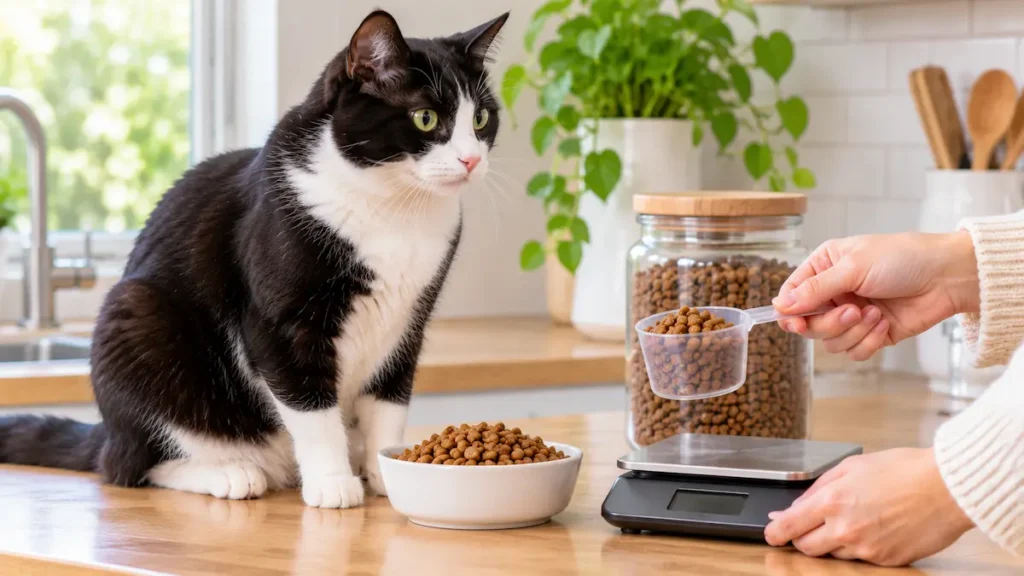
Most healthy, spayed or neutered indoor adult cats need about 20 to 30 calories per pound of body weight per day, so a 10-pound cat needs roughly 220 to 260 kcal daily. With a typical dry food of 400 kcal per cup, that is about 2/3 cup a day; with a 5.5-oz can of wet food at about 180 kcal, it is about 1.5 cans. Always check the calories on your own food’s label, because they vary widely.
- 🧮 Fastest way: use the cat food calculator below
- 📊 By weight: see the cat feeding chart (5 to 20 lb)
- 🥣 Dry vs wet: cups of kibble · cans of wet food
- ⚖️ Is it the right amount? check your cat’s body condition
See the PETLIBRO Granary feeder →
How much should my cat eat? Use the cat food calculator
The cat food calculator below estimates your cat’s daily calories and turns them into cups of dry food and cans of wet food. It uses the standard veterinary formula, 70 × (body weight in kg)0.75, multiplied by a life-stage factor. Enter your food’s calories from the label for the most accurate answer.
Food amounts already leave 10% of calories for treats. This is a starting estimate, not a prescription: weigh your cat every 2 weeks and adjust by about 10%.
Calorie labels make the biggest difference to your result. Dry cat foods range from about 300 to over 500 kcal per cup, and a 3-oz can of wet food can hold anywhere from about 70 to 110 kcal. Look for “Calorie Content (calculated)” on the bag or can, listed as kcal/cup, kcal/can or kcal ME/kg, and type that number in.
How many calories does a cat need a day?
A cat needs its resting energy requirement (RER), 70 × (body weight in kg)0.75, multiplied by a factor for age, neuter status and activity. A 10-lb (4.5 kg) cat has an RER of about 218 kcal, and a typical neutered indoor adult needs about 1.2 times that, or roughly 260 kcal a day. Veterinary nutrition texts such as Hand et al.’s Small Animal Clinical Nutrition use the same approach.
A quicker rule from veterinary sources such as petMD is 25 to 35 kcal per pound of body weight for an average adult. In practice, most indoor neutered cats sit at the lower end of that range, which is exactly why so many indoor cats slowly gain weight on “label” portions. Pet food bag guidelines are written for an average cat, not for a sofa-loving indoor cat.
| Cat | Factor × RER | Example: 10-lb cat |
|---|---|---|
| Kitten under 4 months | 2.5 | Calculate on current weight |
| Kitten 4 to 12 months | 2.0 | Calculate on current weight |
| Neutered indoor adult | 1.2 | about 260 kcal |
| Intact (not neutered) adult | 1.4 | about 305 kcal |
| Inactive or weight-prone adult | 1.0 | about 218 kcal |
| Weight loss (on target weight) | 0.8 | vet-guided only |
How much should a cat eat by weight? Cat feeding chart
A cat feeding chart by weight gives a daily calorie starting point and the matching cups of dry food or cans of wet food. The numbers below are calculated with the RER formula for healthy adults, using a dry food at 400 kcal per cup and a wet food at 180 kcal per 5.5-oz can. If your cat is overweight, use the chart line for your cat’s ideal weight, not its current weight, and consider a calorie-controlled diet from our guide to the best cat food for weight loss.
| Cat weight | Inactive or weight-prone (kcal/day) | Typical neutered indoor adult (kcal/day) | Dry food (cups/day)* | Wet food (5.5-oz cans/day)* |
|---|---|---|---|---|
| 5 lb (2.3 kg) | 129 | 155 | 0.4 | 0.9 |
| 6 lb (2.7 kg) | 148 | 178 | 0.45 | 1 |
| 7 lb (3.2 kg) | 167 | 200 | 0.5 | 1.1 |
| 8 lb (3.6 kg) | 184 | 221 | 0.55 | 1.2 |
| 9 lb (4.1 kg) | 201 | 241 | 0.6 | 1.3 |
| 10 lb (4.5 kg) | 218 | 261 | 0.65 | 1.45 |
| 11 lb (5.0 kg) | 234 | 280 | 0.7 | 1.55 |
| 12 lb (5.4 kg) | 249 | 299 | 0.75 | 1.65 |
| 14 lb (6.4 kg) | 280 | 336 | 0.85 | 1.9 |
| 16 lb (7.3 kg) | 310 | 371 | 0.95 | 2.05 |
| 18 lb (8.2 kg) | 338 | 406 | 1 | 2.25 |
| 20 lb (9.1 kg) | 366 | 439 | 1.1 | 2.45 |
*Based on the “typical neutered indoor adult” column. Use either the dry amount or the wet amount, not both.
Large breeds need extra care with feeding charts. A lean 16-lb Maine Coon and an overweight 16-lb domestic shorthair need very different amounts, because the extra pounds on the second cat are fat, not muscle. See our Maine Coon feeding guide for breed-specific advice.
How much dry food should a cat eat a day?
A typical 10-lb indoor cat eats about 1/2 to 2/3 cup of dry food a day, depending on how many calories the kibble contains per cup. Dry food is energy-dense, at roughly 3.5 kcal per gram (about 100 kcal per ounce), so small measuring mistakes add up fast. An extra tablespoon of kibble a day can add several pounds over a couple of years.
The best tool for dry food is a digital kitchen scale, not a scoop. Detailed feeding guides recommend weighing kibble in grams because “a cup” varies with kibble size and how full you pour it. To convert, divide your cat’s daily kcal by the food’s kcal per kg and multiply by 1,000. For example, 260 kcal ÷ 3,600 kcal/kg × 1,000 is about 72 grams a day.
- Find the calories: read kcal/cup or kcal ME/kg on the bag.
- Get the daily target: use the calculator or chart above.
- Weigh once: weigh the full daily portion in grams, then split it into meals.
- Re-check in 2 weeks: weigh your cat and adjust by about 10% if needed.
Free-feeding a full bowl of dry food is one of the most common indoor cat feeding mistakes we see. If you prefer grazing, measure the whole day’s kibble into the bowl in the morning, and when it is gone, it is gone.
How much wet food should I feed my cat a day?
A typical 10-lb indoor cat needs about one and a half 5.5-oz cans, or about three 3-oz cans, of wet food a day, depending on the food’s calories. Wet food is about 1 kcal per gram (roughly 28 kcal per ounce) because it is around 75 to 80% water, so a cat eats a much larger volume for the same calories. That extra water is a real bonus for cats that drink little, a common issue we cover in why your cat is not drinking water.
When you mix wet and dry food, split the calories, not the volume. If your cat needs 260 kcal and you want half from each, give about 130 kcal of wet food (about 3/4 of a 5.5-oz can at 180 kcal) plus 130 kcal of dry food (about 1/3 cup at 400 kcal per cup). Choose “50% dry / 50% wet” in the calculator to get these numbers for your own foods.
Opened wet food should not sit in the bowl for long. Remove uneaten wet food after about 30 minutes at room temperature, cover the rest of the can and refrigerate it, and use it within about 2 to 3 days. If you are out at work, an automatic wet-food feeder with a cooled compartment keeps meals fresh until feeding time.
Meowant Automatic Wet Food Cat Feeder
Keeps portioned wet meals chilled and opens them on schedule, so cats on wet food can still have 3 small meals while you are at work.
How much should I feed a kitten or a senior cat?
A kitten needs about two to two and a half times the calories of an adult cat per kilogram, because it is growing, so most kittens eat 3 to 4 small meals of kitten food a day. For a full chart by age and a kitten calculator, see how much to feed a kitten. Kittens under 4 months use a factor of about 2.5 × RER, and kittens of 4 to 12 months about 2.0 × RER. Calculate on the kitten’s current weight and recalculate every couple of weeks as it grows. Most cats can switch to adult food around 12 months, while large breeds such as Maine Coons often stay on growth food longer.
Senior cats have more varied needs than any other age group. Many cats aged 7 to 11 become less active and need about 10% fewer calories. Cats over about 12, however, often digest fat and protein less efficiently and may need more food to hold their weight. Unexplained weight loss in an older cat is never “just age,” so check our guide to your cat’s age in human years and talk to your vet about bloodwork.
How do I know if I am feeding my cat the right amount?
You are feeding the right amount when your cat holds a steady weight with an ideal body condition: ribs easy to feel under a thin fat layer, a visible waist from above, and only a small belly pouch. Veterinarians use a 9-point body condition score (BCS) from the World Small Animal Veterinary Association (WSAVA), where 5 is ideal. A score of 6 to 7 means overweight, and 8 to 9 means obese.
Weighing your cat every 1 to 2 weeks is the simplest way to fine-tune portions. Weigh yourself holding your cat, then without, and note the difference. If your adult cat is gaining weight, cut daily food by about 10%; if it is losing weight it should not lose, add about 10%. Keep a simple log, because changes of a few ounces a month are easy to miss by eye.
How many times a day should I feed my cat?
Most adult cats do best with 2 to 4 measured meals a day, and kittens need 3 to 4. Cats are natural “little and often” eaters, and several small meals help with satiety, reduce begging, and keep weight steadier than one large bowl. Split the daily amount from the calculator evenly between meals.
Treats count toward the daily total. Keep treats under 10% of daily calories, a rule recommended by veterinary sources, which is about 25 kcal for a 10-lb cat. Play, brushing and attention work just as well as food rewards, and our guide to exercising your cat at home shows easy ways to burn extra calories. In multi-cat homes, feed cats in separate spots or use a microchip feeder, so the fastest eater does not take everyone’s portion.
Make portion control automatic
- PETLIBRO Granary WiFi feeder: schedules up to several small dry meals a day with exact portions, set from your phone.
- PETLIBRO One RFID feeder: opens only for the microchipped cat, ideal for diet food or multi-cat homes.
- Works with the calculator: enter your daily cups, divide by meals, and set the feeder once.
Affiliate links · Compare more models in our best automatic cat feeder guide
When should I talk to my vet about how much my cat eats?
Talk to your vet if your cat’s appetite or weight changes without a clear reason, or if your cat skips meals for more than 24 hours. A cat that suddenly eats more but loses weight may have hyperthyroidism or diabetes, while a cat that stops eating is at risk of fatty liver disease within days. Our guide to why a cat is not eating covers the warning signs in detail.
- Weight change: any unplanned loss or gain of more than about 10% of body weight.
- Appetite change: eating much more or much less than usual for more than a day or two.
- Extra thirst or urination: often linked with kidney disease, diabetes or thyroid disease.
- Weight-loss plans: any cat with a BCS of 7 or more needs a vet-guided calorie target.
Frequently asked questions
How much dry food should a 10-pound cat eat a day?
A 10-pound neutered indoor cat usually needs about 1/2 to 2/3 cup of dry food a day. That equals about 220 to 260 kcal with a kibble of 400 kcal per cup. Check your bag’s kcal per cup and adjust, because richer foods need smaller portions.
How many cans of wet food should a cat eat a day?
Most average adult cats need about one 5.5-oz can per 6 to 7 pounds of body weight per day. A 10-lb cat typically eats about 1.5 cans of a 180 kcal food. Calories per can vary a lot, so use the label and the calculator.
Is it OK to leave dry food out all day for my cat?
Leaving unlimited dry food out all day often leads to overeating and weight gain in indoor cats. If your cat likes to graze, measure the full daily portion into the bowl each morning instead. Timed feeders and puzzle feeders also slow fast eaters.
How much should I feed my cat to lose weight?
A cat losing weight usually eats about 80% of the calories it needs at its target weight, under a vet’s guidance. Enter the target weight and choose “weight loss” in the calculator for a starting figure, and see the best weight-loss cat foods. Aim for slow loss of about 0.5 to 2% of body weight per week, and never starve a cat. Our cat weight loss guide has a dedicated calculator.
Why is my cat always hungry?
Many cats beg out of habit or boredom, but constant hunger can also signal hyperthyroidism, diabetes or intestinal parasites. First, make sure you are feeding enough calories for your cat’s ideal weight. If your cat eats well but loses weight, see your vet.
How many calories are in a cup of cat food?
Most dry cat foods contain about 300 to 550 kcal per cup. Weight-control formulas are at the lower end and high-protein or kitten foods at the higher end. Wet food is about 1 kcal per gram, so roughly 70 to 110 kcal per 3-oz can.
- petMD, How Much To Feed a Cat
- Catological, Cat Feeding Guide for Wet and Dry Cat Food
- Outdoor Bengal (Neus Torrent, DVM), A Veterinarian’s Guide to Calculating Your Cat’s Daily Food Needs, citing Hand MS et al., Small Animal Clinical Nutrition, 5th ed., 2010
- World Small Animal Veterinary Association, Global Nutrition Guidelines and Body Condition Score tools
Vet note: this calculator gives general estimates for healthy cats. Cats with kidney disease, diabetes, hyperthyroidism, pregnancy or a weight-loss plan need a calorie target set by their own veterinarian.