Home › Cat Litter Box › Where Should I Put My Cat Litter Box?
Where Should I Put My Cat Litter Box? 10 Rules, Best Rooms & Placement Scorecard (2026 Guide)
30-Second Summary for Cat Parents
The ideal location for a cat litter box is a quiet, low-traffic room with 24/7 continuous access, multiple escape routes, and a clear line of sight. Always separate litter stations from food and water bowls by at least 6 to 10 feet to satisfy natural feline hygiene instincts. Avoid noisy appliances like washing machines, tight dead-end closets where a cat can feel cornered, or rooms with doors that human family members frequently shut. In multi-cat households, follow the N+1 rule (1 box per cat plus 1 extra) and distribute boxes across different rooms or floors rather than placing them side-by-side.
Choosing where to put a cat litter box seems simple until your cat starts urinating on the rug, crouching nervously in the hallway, or refusing to enter the bathroom. Many cat parents select a location based on human convenience—hiding the box in a dark basement corner, squeezing it behind a laundry hamper, or tucking it into a closed closet. However, cats view their bathroom environment through a survival lens.
Elimination places a feline in a physically vulnerable position. If a litter box is situated near a thumping washing machine, in a cramped nook with only one exit, or right beside a barking dog’s bed, your cat may experience chronic stress, leading to litter box avoidance, urinary holding, or stress-induced cystitis (FLUTD). This comprehensive guide breaks down the 10 golden rules of litter box placement, evaluates every room in your home, provides a room-by-room decision matrix, offers an interactive location scorecard, and explains how to relocate a box without triggering household accidents.
The 10 Golden Rules for Litter Box Placement
Before deciding which room to use, evaluate the micro-environment of the specific spot. A bathroom or bedroom can be an outstanding location in one house and a major failure in another depending on these 10 clinical placement principles:
1. Provide 24/7 Uninterrupted Accessibility
Your cat must be able to reach their litter box every second of the day or night. Never place a box in a room where the door might accidentally slam shut, be latched by guests, or be closed overnight. If a bathroom or bedroom door is shut for privacy, install a interior pet door or door strap to ensure permanent entry.
2. Isolate from Heavy Acoustic Noise & Vibrations
Avoid placing litter boxes directly next to loud appliances such as washing machines, tumble dryers, loud refrigerators, or furnace units. Sudden spin cycles, buzzing alarms, or mechanical thumps while a cat is inside the box can startle them, creating a lasting fearful association with that location.
3. Ensure Two-Way Sightlines & Unobstructed Escape Routes
Cats are both predators and prey. When using the bathroom, they need to see approaching threats (other household cats, dogs, or toddlers) and have at least two clear escape paths. Avoid placing boxes at the end of long, narrow dead-end hallways or tucked behind deep furniture where a cat can easily be cornered or ambushed.
4. Maintain Strict Scent & Feeding Line Isolation
In the wild, felines never eliminate near their hunting or feeding grounds to prevent food contamination and avoid alerting predators. Keep litter boxes at least 6 to 10 feet away from food bowls, water fountains, and feeding stations. Placing food and litter side-by-side suppresses appetite and causes chronic stress.
5. Follow the N+1 Geographic Distribution Rule
The clinical standard established by the American Association of Feline Practitioners (AAFP) is one litter box per cat in the household, plus one extra (N+1). Crucially, these boxes must be spread across different geographical locations or rooms. Placing three litter boxes side-by-side in one basement line counts as a single giant litter station from a cat’s territorial perspective.
6. Choose Low-Traffic, Predictable Privacy Nooks
Cats prefer privacy without total isolation. High-traffic zones—such as main entryways, busy kitchen walkways, or living room centers—expose the cat to constant foot traffic. A quiet corner of an office, guest bedroom, or low-traffic living room perimeter provides the ideal balance of calm and security.
7. Balance Airflow, Ventilation & Temperature
Air quality matters for both humans and cats. Avoid sealed, unventilated closets or damp crawl spaces where ammonia fumes and dust accumulate. Ensure adequate ambient airflow without placing the box directly under cold AC blasts, heating vents, or drafty exterior doorways.
8. Optimize Ergonomics for Daily Human Maintenance
If a litter box is placed in a difficult-to-reach spot—such as under a low bed, deep inside an attic, or down steep stairs—daily scooping naturally suffers. A clean box is vital for feline health; choose a spot that allows you to scoop solid waste easily at least once or twice a day.
9. Accommodate Senior Cats & Mobility Limitations
Arthritic senior cats and young kittens cannot navigate steep staircases or high barrier steps. For older cats suffering from feline osteoarthritis, place litter boxes on the main floor where they spend most of their time, and select boxes with low entry thresholds (2.5 to 3.5 inches).
10. Enforce a Gradual Relocation Protocol
Never move a litter box overnight from one end of the house to another. Cats rely heavily on spatial memory and scent markers. If you must relocate a box, move it gradually by 2 to 3 inches per day, or set up a second box in the new location first before removing the old one.
Best Cat Litter Box Locations by Room: Advantages vs. Risks
No single room is universally perfect for every household. Evaluate the pros and cons of each potential room using this clinical breakdown:
| Location | Key Advantages | Potential Risks & Drawbacks | Clinical Verdict |
|---|---|---|---|
| Bathroom | Hard, washable flooring; easy waste disposal; nearby water source for cleaning. | Door frequently closed by family/guests; limited floor space in small bathrooms. | Excellent — provided the door is permanently secured open or equipped with a strap. |
| Bedroom / Guest Room | Quiet, low foot traffic; predictable temperature; continuously accessible. | Litter tracking on carpets; minor odor if daily scooping is neglected. | Very Good — highly recommended for apartment living or anxious cats. |
| Living Room Perimeter | Spacious; easy human maintenance monitoring; excellent escape routes. | High visual exposure; potential noise during social gatherings. | Good — ideal when tucked into a quiet, low-traffic perimeter corner. |
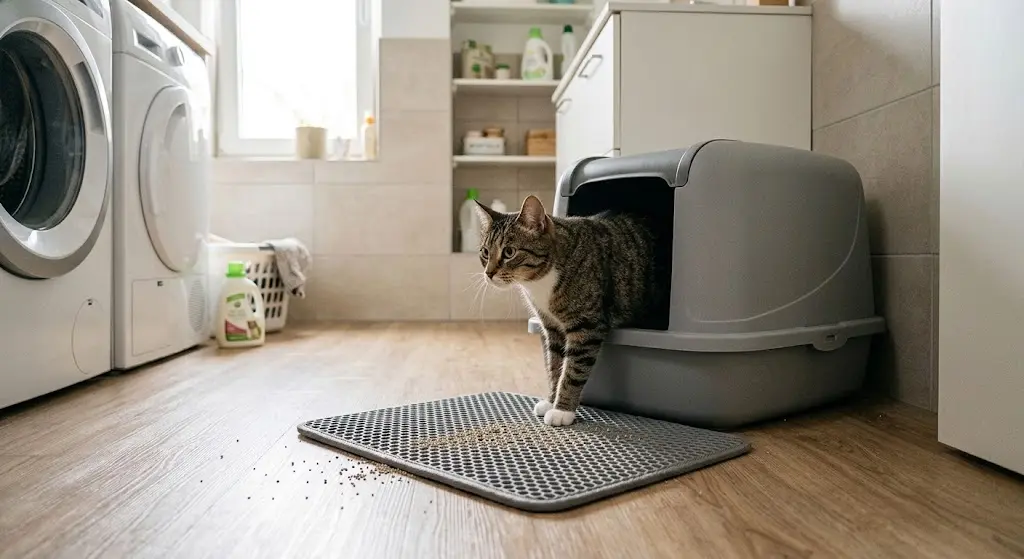
| Laundry Room | Tiled flooring; out of main living sightlines; easy isolation. | Washer/dryer spin cycle noise, vibration, and detergent chemical fumes. | Conditional — acceptable only if machinery is quiet and non-frightening. |
| Closet / Cabinet | Hides box from human sight; controls litter tracking. | Poor ventilation, trap hazard, dark environment, difficult daily scooping access. | Poor to Fair — avoid sealed closets; use open walk-in closets only. |
| Basement | Private, spacious; out of human living areas. | Stair access barrier for seniors; cold/damp concrete; dark ambush hazard. | Conditional — fine as an extra box, but poor as the sole box in multi-story homes. |
| Garage or Balcony | Keeps litter dust and odor completely outside the home. | Extreme temperature fluctuations, toxic vehicle fumes, total access lockout risks. | Unsafe / Unacceptable — strong veterinary warning against outdoor/garage spots. |
Where Should You Put Cat Litter Box in an Apartment or Studio?
Apartment and studio living presents unique spatial challenges because human living, sleeping, and dining areas occupy a small square footage. However, hiding the box in a tiny cabinet or blocking access to save floor space frequently backfires into carpet accidents.
3 Practical Apartment Placement Options
- Option 1: The Bathroom Nook with Door Prop — Place the box along a non-walking wall in the bathroom. Use an adjustable door strap or floor wedge so the door stays open 4 to 6 inches, allowing the cat entry while maintaining privacy.
- Option 2: The Bedroom Perimeter Corner — Position the box in a quiet bedroom corner away from direct bed sightlines. Pair it with a high-sided box, a double-layer honeycomb litter mat, and an active carbon air purifier to eliminate tracking and odor.
- Option 3: Decorative Litter Enclosure / Credenza — If the box must live in the main living area, use a spacious wooden credenza enclosure with dual entry/exit ports and wide interior dimensions so your cat does not feel trapped.
Litter Box Locations for Multi-Cat & Multi-Story Homes
In homes with two or more cats, litter box placement becomes a exercise in feline social engineering. Cats establish subtle territorial boundaries. A dominant or bully cat may guard a hallway or stairwell, preventing a timid cat from reaching a lone basement litter box.
Multi-Cat Placement Guidelines
- Separate Scent Territories: Place litter boxes in completely different rooms or opposite sides of the house so a single cat cannot visually or physically guard all resources.
- Avoid Adjacent Box Lines: Lining up three litter boxes in a single row does not create three stations—it creates one large station. Spread them out across different rooms.
- Multi-Story Rule: In two-story or three-story homes, place at least one litter box on every inhabited level. Forcing an elderly or timid cat to navigate two flights of stairs to eliminate is a primary cause of senior house-soiling.
Litter Box Location Scorecard: Is Your Current Spot Good?
Evaluate your prospective or current litter box location using our clinical 18-point decision scorecard. Answer “Yes” or “No” to each criteria below:
| Evaluation Criteria | Points for YES |
|---|---|
| Is the location continuously accessible 24 hours a day without closed doors? | 2 Points |
| Is the spot away from loud appliances (washers, dryers, furnaces, loud speakers)? | 2 Points |
| Is the box placed at least 6 feet away from food and water bowls? | 2 Points |
| Does the cat have a clear view of approaching people or other pets? | 2 Points |
| Is there at least one clear alternative escape route so the cat cannot be trapped? | 2 Points |
| Is the area relatively quiet with low to moderate household foot traffic? | 2 Points |
| Can you comfortably reach and scoop the box every day without awkward bending? | 2 Points |
| Is the temperature stable (no freezing drafts, hot vents, or garage extremes)? | 2 Points |
| Is the floor surface hard, level, and easy to sanitize (tile, vinyl, wood, or mat)? | 1 Point |
| Is there adequate ambient lighting so the cat can navigate at night? | 1 Point |
Scorecard Interpretation
- 16 – 18 Points (Optimal Spot): Outstanding location. Your cat feels safe, accessible, and comfortable.
- 12 – 15 Points (Acceptable): Good spot, but address any “No” answers (e.g., move food bowls farther away or add a door prop).
- 8 – 11 Points (Needs Relocation): Sub-optimal. High risk of feline stress or litter box avoidance. Plan a gradual move.
- Below 8 Points (Poor / Unsafe): High-risk location. Expect house-soiling accidents or FLUTD flare-ups. Relocate immediately.
How to Move a Litter Box Without Causing Accidents
If your scorecard reveals that your current litter box location is poor, do not abruptly move the box to a new room overnight. Sudden spatial changes confuse cats, leading them to eliminate in the old familiar spot on the floor.
The 2-Step Safe Relocation Protocol
- Method A: The Gradual Nudge (Short Distances <10 feet) — Shift the litter box by 2 to 4 inches each day toward the new location. Keep the path clear and maintain daily scooping so the cat follows the scent line smoothly.
- Method B: The Dual-Box Bridge (Long Distances or Different Floors) — Set up a brand new, fully equipped litter box in the target location while leaving the original box in place. Encourage the cat to use the new spot with praise and treats. Once the cat uses the new box consistently for 7 to 10 consecutive days, quietly remove the old box.
12 Common Litter Box Placement Mistakes to Avoid
- Placing the litter box directly beside food and water bowls.
- Positioning the box next to a noisy washing machine or clothes dryer.
- Putting the box in a room where the door is frequently closed.
- Hiding the box inside a dark, unventilated closet.
- Placing the box at the end of a narrow dead-end hallway.
- Lining up all litter boxes side-by-side in a single basement row.
- Forcing senior or arthritic cats to climb steep stairs to reach their only box.
- Allowing dogs or toddlers to guard or block the litter box entrance.
- Squeezing a box under low furniture where the cat cannot stand fully upright.
- Placing the box in a high-traffic entryway or central living room path.
- Moving the box suddenly across the house without a transition period.
- Selecting a location so inconvenient that you skip daily scooping.
Frequently Asked Questions About Litter Box Placement
Can I put a cat litter box in the bedroom?
Yes. A quiet bedroom corner is often an excellent location, especially in apartments or multi-cat homes where other rooms are busy. Keep the box away from your bed’s headboard, scoop daily, and use a low-dust, clumping litter paired with an air purifier to maintain fresh air.
How far should a cat litter box be from food and water?
Separate litter boxes from food and water bowls by at least 6 to 10 feet. In small apartments, place them in different rooms or opposite sides of the living area. Instinctively, cats avoid eating near elimination sites to prevent food contamination.
Is it okay to put a litter box in the laundry room?
A laundry room works well only if your cat is completely unbothered by the washer and dryer. If the machine vibrates heavily, buzzes loudly, or sudden spin cycles startle your cat, choose a quieter location to prevent fear-based house-soiling.
Should a litter box be covered or open?
Most veterinary behaviorists recommend open-top litter boxes. Open boxes provide superior ventilation, 360-degree sightlines, and multiple escape routes. Covered or hooded boxes trap dust and odor inside, making the environment unappealing to sensitive feline noses.
Where should I put litter boxes in a multi-cat home?
Distribute boxes across multiple distinct rooms or floors so no single cat can territorial-guard all bathroom access points. Remember the N+1 rule: if you have 3 cats, provide 4 litter boxes spread across separate locations.
Why is my cat peeing right next to the litter box?
Peeing directly beside the box indicates that your cat wants to use the location, but something about the setup is wrong. Common causes include a dirty box, a box that is too small, an entry height that causes joint pain, or an intimidating hood/cover. Always rule out a urinary tract infection (UTI) with your vet.
Can I put a litter box in a closet?
Only if the closet door is permanently fixed open, the space is well-ventilated, and there is ample room for the cat to enter, turn, and exit without feeling cornered. Small, dark, or closed closets should be strictly avoided.
Editorial Disclosure: Happy Cat At Home is reader-supported. When you buy through links on our site, we may earn an affiliate commission at no extra cost to you. All product recommendations are independently vetted and medically reviewed by our veterinary team. This guide is for educational purposes and does not replace direct professional veterinary care.