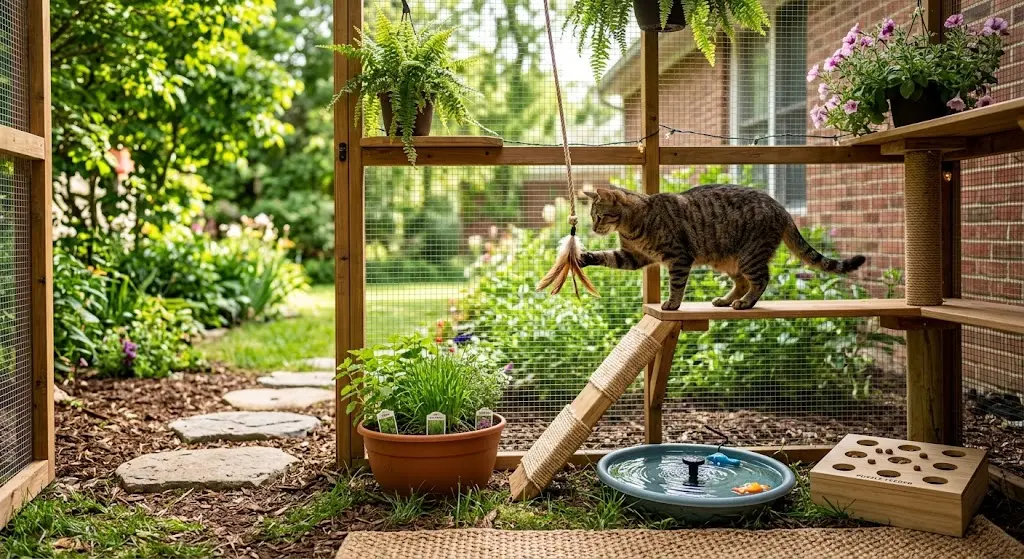
Vertical Territory: Designing a Cat-Friendly Home That Still Looks Like a Home
Most cat furniture is designed for cats and tolerated by humans. The beige carpeted tower in the corner of the living room is a compromise — a piece of equipment that announces itself as pet gear, competes with the sofa for floor space, and rarely matches anything else in the room.
But cats do not actually need dedicated furniture. They need vertical territory: height, sightlines, and surfaces that let them move through a space the way their instincts tell them to. Once you understand that, the design problem changes. Instead of buying a product, you are editing a room.
This is a guide to building that territory using the materials, proportions, and restraint you would apply to any other part of your home.
Why Cats Need Height (and Why It Is Not Just Climbing)
A cat is both predator and prey, and that dual inheritance shapes how it reads a room. The floor is where things happen to a cat. Height is where a cat happens to things.
Behavioural research on domestic cats consistently links access to elevated resting spots with lower stress markers and less conflict — a finding that matters most in multi-cat households, where vertical space functions as a set of parallel corridors. Two cats that cannot comfortably share a floor can often coexist peacefully if each has its own route and its own perch.
So height is not entertainment. It is infrastructure. A cat that has nowhere to go up will find somewhere anyway — the top of the refrigerator, the open wardrobe shelf, the back of a dining chair — and those improvised perches are usually the ones that look worst in a photograph.
Start With Sightlines, Not Cat Trees
Before buying anything, spend a week watching where your cat already goes. You will usually find three or four consistent points: a windowsill in the afternoon, the end of a sofa with a view of two doorways, a kitchen counter at the same time every morning.
Those are the places worth designing around. The goal is not to add furniture, but to make the spots your cat already prefers more comfortable and more permanent — a cushion on the windowsill instead of a folded towel, a wall-mounted shelf where the cat has already worked out it can jump.
Three questions define the plan:
- What can be seen from here? Cats prefer perches with a wide field of view, ideally covering a doorway and a window.
- How is it reached? The route matters more than the destination. A perch that requires one awkward leap will be used less than one reachable by three easy steps.
- What is underneath? A high perch with a hard landing gets avoided. Soften what is below.
The Three Heights Every Cat Home Needs
A functional layout has three layers, and most homes are missing at least one.
The observation layer sits at roughly windowsill height — 60 to 90 cm. This is where a cat spends the day. It should face something worth watching: a street, a garden, a bird feeder, a hallway where people pass. A low bench under a window, a deep sill, or a simple shelf does the job.
The transit layer is the connective tissue: the path from one height to another. It is the layer most people skip entirely, which is why so many cats end up making a single dramatic leap onto a wardrobe. Wall-mounted shelves, a sturdy bookcase, a stack of well-weighted boxes — the goal is a route with steps a cat can take without hesitation.
The territory layer is the highest point in the room. One is enough. It should be soft, stable, and slightly enclosed — a cat resting at the top of a room wants a wall or a corner at its back. A shelf in a corner niche, or a basket on top of a tall cabinet, works better than an open platform in the middle of a wall.
Materials That Age Well
The fastest way to make cat territory look like cat gear is to use the materials sold with it: bonded carpet, printed fabric, moulded plastic. They read as equipment because they are.
The alternative is to specify the same materials you would use anywhere else in the house:
- Solid timber for shelves and steps — oak or ash, oiled rather than lacquered, so scratches can be sanded out.
- Wool for anything the cat will lie on. It resists odour, holds up to claws better than synthetic fleece, and looks like a textile rather than a pet product.
- Leather or heavy canvas where a surface will take traffic. Both develop a patina; both can be repaired.
- Cork or felt pads underneath anything that moves. Small detail, large effect on how considered a room feels.
Avoid anything that cannot be cleaned or repaired. Cat territory takes wear, and a surface you are afraid to damage will always look damaged.
Small-Space Solutions
In an apartment, vertical territory is not a luxury — it is the only way to give a cat space without giving up floor.
The most effective moves are quiet ones. A floating shelf above a desk creates a perch that costs no floor area and reads as part of the wall. A tall bookcase with one shelf left deliberately clear becomes a lookout. A windowsill widened by a simple timber board becomes the best seat in the house.
A note on storage furniture: side tables and cabinets with an integrated opening are useful, but only if the opening is positioned where a cat actually wants to rest. An enclosed cubby in a dark corner will be ignored. The same cubby beside a window, at the right height, will be occupied within a day.
The Invisible Details: Scent, Light, and Quiet
Design for cats is not only visual. Three sensory details determine whether a space actually gets used.
Scent. Cats mark and re-read territory by smell. Washing everything weekly — bedding, covers, cushions — erases the information a cat depends on. Wash less, air more, and use unscented detergent.
Light. Cats seek warm pools of light. If a room has one strong window, the territory should follow it; there is little point building a beautiful perch in the darkest corner of the house.
Quiet. A perch near a washing machine, a speaker, or a busy doorway will be avoided no matter how well designed it is. The best perches are usually boring places: corners, alcoves, the ends of corridors.
This is also where modern pet technology can be integrated well or badly. A camera or a water fountain placed as an appliance becomes clutter. The same device, sized and finished to sit inside the existing scheme, disappears — which is how it should be. Technology that respects the room is used more, and photographed less.
A Home That Works for Both of You
The assumption that a cat-friendly home requires cat furniture is the reason so many of them end up looking like pet shops. The alternative is simpler and cheaper: watch where your cat already wants to be, then build that place properly — in timber, wool, and light, at the three heights that matter.
The result is a room that has not been given over to a pet. It has simply been read correctly. A cat that has its own territory, its own routes, and its own quiet corner will use the sofa less, scratch the furniture less, and spend more of the day doing exactly what it wants — a few feet above the floor, in a place that was always meant to be there.
About the author
Xiao Hisen is the founder of OpenClaw Pets, a brand designing quiet, subscription-free smart pet technology — LTE-M GPS trackers, AI vision pet cameras, and stainless-steel water fountains built for homes that are designed, not filled.